


At 23, Zhang Zihan (张子瀚) is trying to make dedicated satellite launches cheap enough to compete with sharing a ride on a bigger rocket. His company, Z-TRAK SPACE, is building a small reusable rocket so customers can choose their orbit and launch schedule without paying today’s dedicated-launch prices.
Z-TRAK’s proposed rocket, Fission-A (裂变号-A型), is designed to carry one or more satellites with a combined weight of up to 450 kg into low Earth orbit. The first-stage booster powers the initial ascent, then separates; the upper stage carries the satellites the rest of the way into orbit. Z-TRAK plans to land the booster and fly it again, spreading the expense of building it across multiple launches.
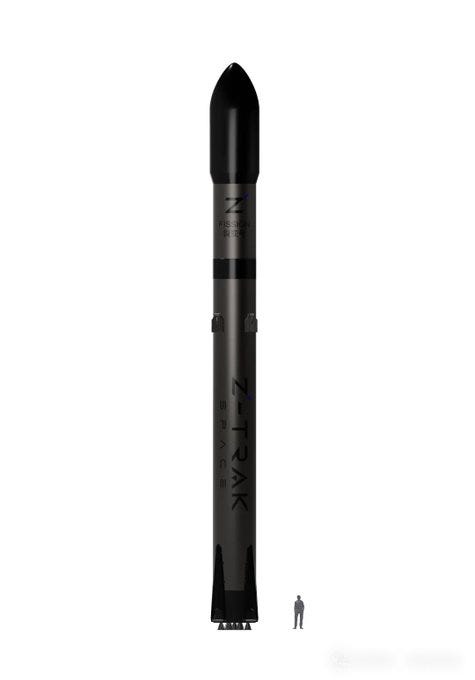
A satellite owner can buy space alongside other customers on a shared launch, or book a whole launch around its own mission. Sharing spreads the cost among customers, but the satellite has to fit the flight’s orbit and timetable. A dedicated launch gives the customer more control over both, while leaving it to cover the launch bill. Z-TRAK says rideshare customers wait an average of 6.8 months; it wants to make booking a whole launch a more affordable alternative.
The amount a rocket can carry depends on the orbit it needs to reach. Fission-A’s planned maximum is 450 kg to low Earth orbit, falling to 300 kg for a sun-synchronous orbit. That is a type of low Earth orbit used by imaging satellites to revisit a location under consistent sunlight, making changes on the ground easier to compare.
For a whole launch carrying up to 450 kg to low Earth orbit, Z-TRAK targets a cost below ¥15M ($2.24M). SpaceX’s published rideshare tariff charges ¥14.1M ($2.1M) for a customer to send 300 kg to sun-synchronous orbit alongside other customers’ satellites.
SpaceX already reuses Falcon 9 boosters on both dedicated and shared launches; the upper stage is used once. Z-TRAK is trying to bring booster reuse to a much smaller rocket, so a small-satellite customer could afford the whole launch rather than a share of a larger one.
Zhang says he grew up building rocket models and wrote the business plan with classmates in a Shenzhen co-working space in October 2024. He says he is still studying aerospace engineering at Hong Kong Polytechnic University. The venture has since moved to Zhuzhou, Hunan, through a local government program that uses investment to attract businesses.
On September 29, 2026, Z-TRAK announced a “¥100M-level” (~$14.9M) angel-plus round, its latest round of early-stage funding. Investors bought about 10% of its Hunan operating company at a reported valuation of ¥1B ($149M) after the investment, up from ¥300M ($44.7M) in May. Returning investor Zhuzhou Beidou Group (北斗集团), a local state-owned investment company, is helping establish Z-TRAK’s development and manufacturing base. The team has tested an engine on the ground; the rocket has yet to fly.
Batteries behind the burn
Z-TRAK uses batteries to power the pumps that feed methane and liquid oxygen into its engine’s combustion chamber. The methane burns to produce thrust; battery-powered electric motors drive the pumps, replacing the gas turbine used in many liquid-fueled rocket engines. This simplifies the machinery and makes thrust easier to adjust, which matters when slowing the booster for landing. Zhang said in a July 2026 interview that the team built its first engine prototype for under ¥500,000 ($74,600).
