


Talls Gear (陶世智能), a Shenzhen robotics-component maker, raised ¥140M (~$20.8M) in an A round, valuing it above ¥1B (~$148M). Talls makes the tiny gear that lets a robot’s wrist or finger bend at a right angle, the kind of joint a humanoid hand needs. The usual way to do it bolts a second gear stage onto the joint; Talls does it in one smaller, cheaper piece that also holds its position without a brake, and it has already signed supply deals for 100,000 units as robot-hand makers move toward volume production. The round was backed by Guangzhou State-Owned Capital (广州国控), Qianhai Financial Holdings (前海金控) and two other investors, with DeTai Capital (德太资本) advising.
Why build a company around one joint? Because the hand is where a humanoid does its job. Legs get the robot to the work; the fingers do the work, and packing real dexterity into a human-sized hand is one of the hardest parts of the whole machine. Every joint needs a reducer (the small gearbox that turns a motor’s fast spin into a joint’s slow, controlled movement), and every reducer costs space, money and power.
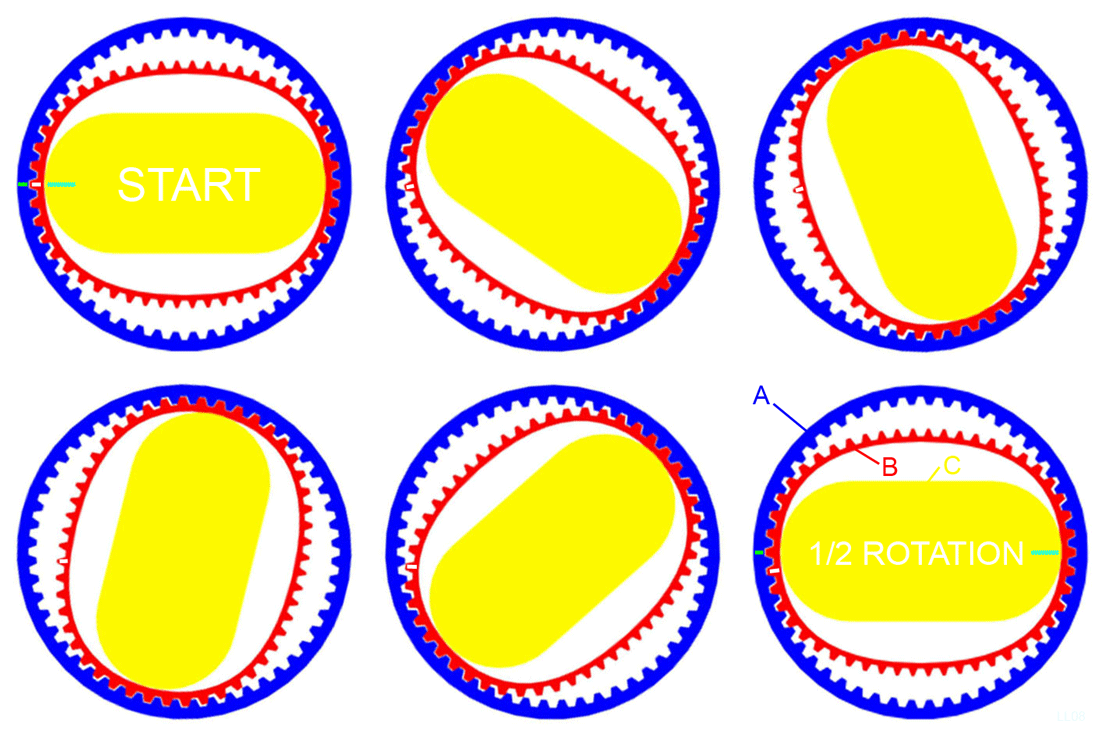
One that is smaller, cheaper and self-locking is much more than a spec-sheet nicety. Without it, a joint either burns motor power to hold a grip, which drains the battery over a shift, or needs a separate brake bolted on, another part, more weight, one more thing to fail. A self-locking joint holds that grip for free, whether it is clamped on a tool for a minute of fine assembly work or carrying a box across the floor, and it lets a hand pack more independent fingers into the same space. The early buyers point to where that lands first: the dexterous-hand makers themselves, and electronics assemblers that want robots doing fine-motor work on the line.
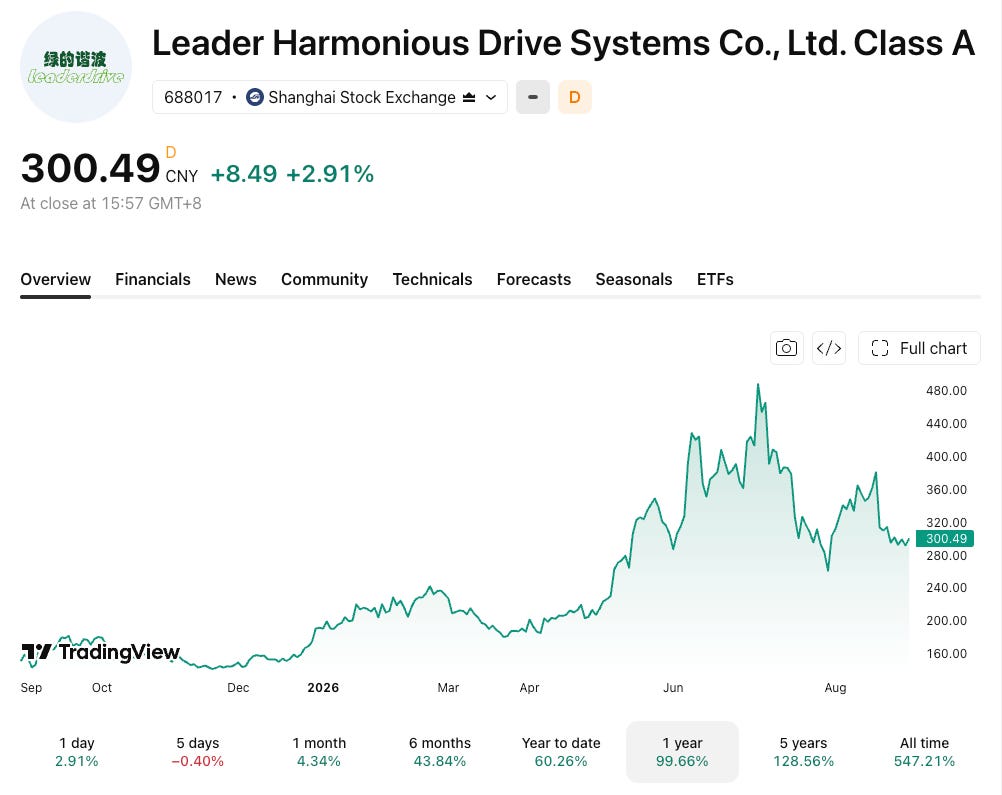
Global humanoid robot shipments reached about 13,000 units in 2025, per market researcher Omdia, led by Chinese manufacturers, and Morgan Stanley expects China alone to ship 50,000 this year. Each one needs dozens of reducers. The dominant technology is the harmonic reducer, a coaxial gear (input and output share the same axis) that sits inline between motor and joint. One listed Chinese player, Leaderdrive (绿的谐波, 688017), shipped 425,000 harmonic reducers in 2025 and, per a 2026 disclosure, its share of the harmonic reducers going into Chinese humanoid robots had risen to 80-90%, up from around 70% in 2025.
The coaxial design’s structural constraint means power moves in a straight line, not around a corner. For joints that need a 90° turn, a wrist rotating perpendicular to the forearm or a finger bending off the palm, a harmonic reducer cannot do the job. Among reducer-based designs, the current workaround, the second…