


The China Round is a weekly report tracking venture and strategic investment activity across China’s core technology sectors: AI, robotics, semiconductors, new energy and materials, aerospace and defense, and frontier tech.
Where capital flows is where talent concentrates, where production capacity gets built, and where the next commercial technologies will come from.
The China Round is published weekly, and written for investors, operators, and founders tracking where China’s tech capital is moving and why it matters.
About the author: Dermot McGrath is Irish, based in Shanghai, a decade in China’s tech and investment ecosystem, fluent Mandarin. Co-founded a VC fund scaled to nine-figure AUM. Now running ZenGen Labs, a cross-border strategy studio covering AI, robotics, and deep tech.
This week’s 183 deals ranged from a fold-away home robot to AI shrunk into a pair of headphones, but a handful kept circling the same question: who draws the line between foreign and domestic technology, and which side of it a company lands on. China draws it one way, pulling the work home. A design-software maker hit an ¥8B (~$1.15B) valuation, close to the listed domestic leader’s market value in early September, on a CAD package (the 3D software factories draw their parts in) whose core engine it licenses from Siemens, just as the state’s buy-domestic drive makes owning that engine the whole point. A seed-stage startup that says it serves three million users across Pakistan, Nigeria and Bangladesh moved its AI off Google’s cloud onto Chinese chips in Shanghai, months before the city made that shift official policy. Japan draws it the other way, and a Shanghai developer is wiring Chinese cells into Japan’s grid through a Japanese operating company, hoping to clear a security certificate no Chinese battery maker has yet passed.
The largest cheques, though, went to teams priced on a résumé more than a product. An OpenAI returnee pointing the large-model recipe at robot bodies raised roughly ten times the typical round at his stage, and the single biggest new round skipped the model labs for the compute layer beneath them.
Where the Money Went
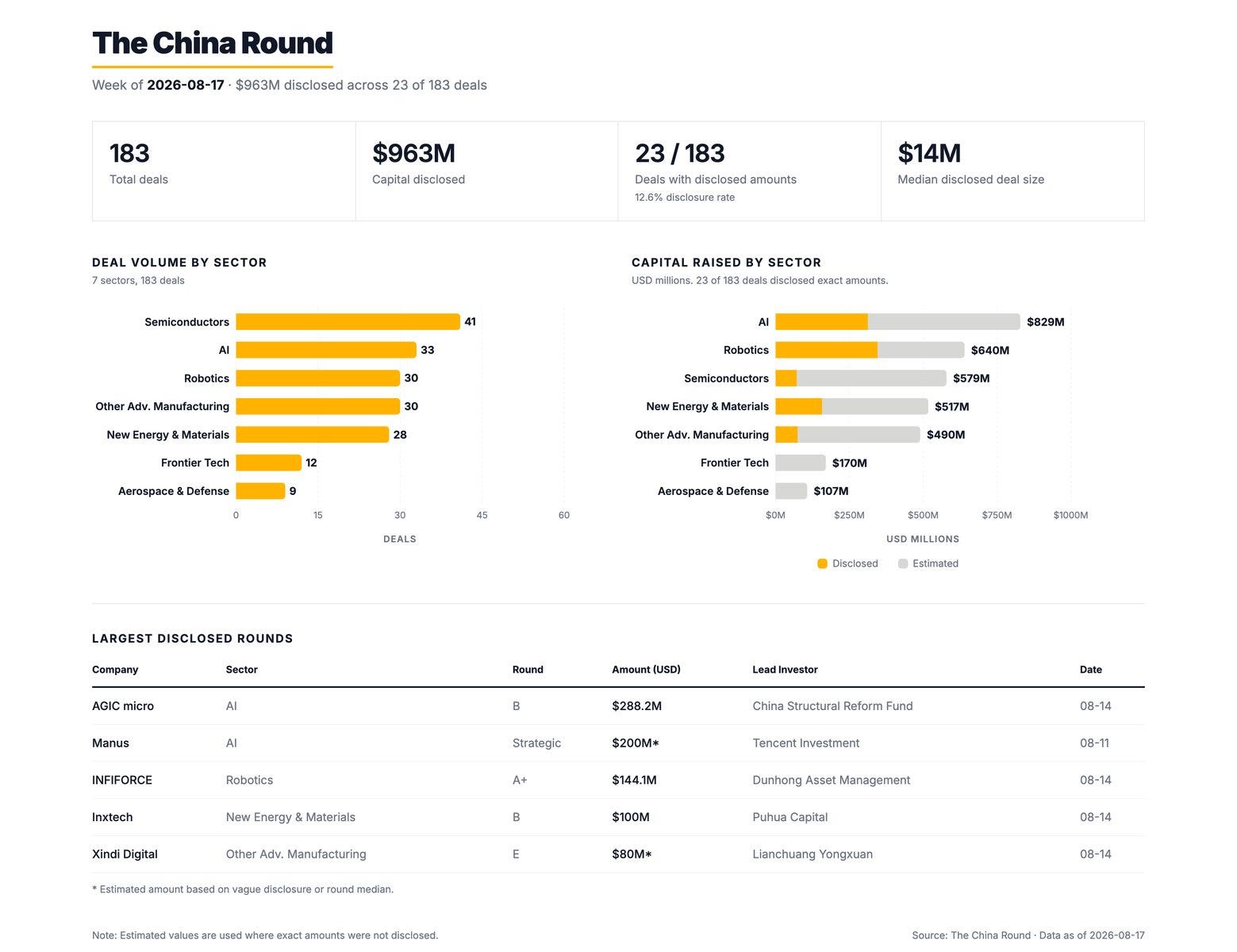
Semis 41 | AI 33 | Robotics 30 | Adv Mfg 30 | Energy 28 | Frontier 12 | Aero 9
183 deals | 23 disclosed a combined $963M (~¥6.7B) | median disclosed $14M (~¥100M)
Semiconductors were the week’s densest lane by count, 41 of 183 deals, but robots pulled the most disclosed capital, about $346M (~¥2.4B) across their rounds, just ahead of AI’s $313M (~¥2.2B). The single biggest new round went to AI, over ¥2B (~$288M) to AGIC micro (谦合益邦), a chip designer building compute-in-memory processors that do the arithmetic where the data already sits instead of shuttling it to a separate chip, the bottleneck that makes AI inference slow and power-hungry. The state’s China Structural Reform Fund anchored it, one of several teams this week chasing the same problem. Robotics’ total was spread wider and mostly priced on pedigree, with INFIFORCE’s ¥1B (~$144M) A+ round and Knowin’s ¥500M (~$72M) angel both backing pre-shipping robot-AI teams out of Huawei and the big model labs. Energy and materials ran quieter but pointed offshore, Inxtech’s $100M (~¥695M) round for solid-state batteries aimed at drones and eVTOLs (battery-powered air taxis), Taoke building and trading grid batteries inside Japan. Only 23 of the 183 rounds published an amount, so the $963M is a floor, most of the week’s capital is undisclosed, and the state funds behind the largest cheques are doing most of the disclosing.
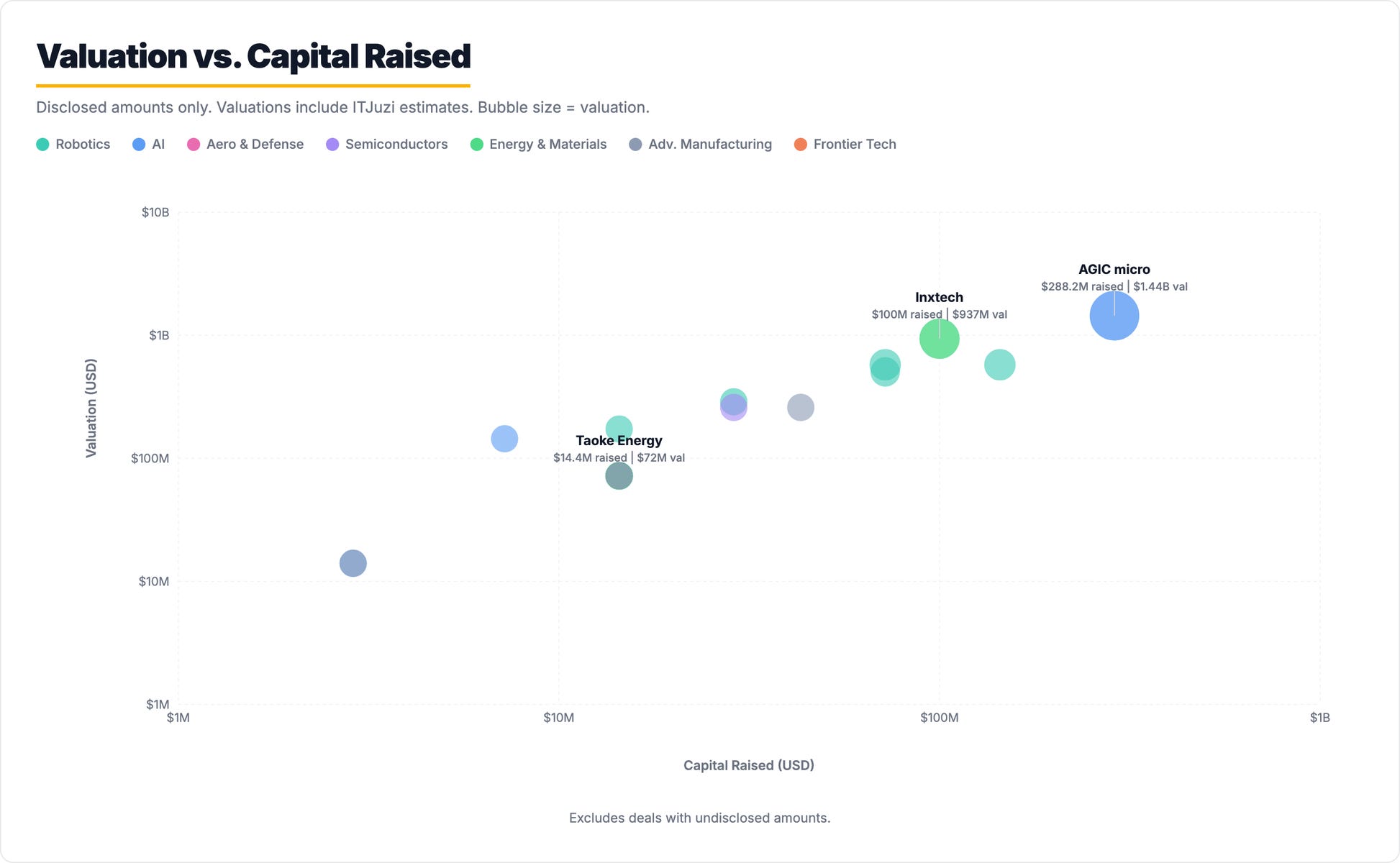
Spotlights
Omnimind (万象智维)
Angel+ · Tens of millions RMB (single-digit millions USD) · Valuation undisclosed
A 30-person Tsinghua spinout building the software layer that runs AI agents on the device itself rather than in the cloud, with a bone-conduction headphone maker leading the round.
Omnimind builds the plumbing for running AI models and agents on phones, PCs and gadgets instead of on cloud servers. Doing the work on the device is cheaper, with no per-token bill to a cloud provider and a reach to hosted models only when the local one cannot cope, and more private, since anything handled on the phone never leaves it, which matters most when the agent is operating your other apps for you. Incubated in 2025 out of Tsinghua’s ubiquitous-intelligence lab, it is…