


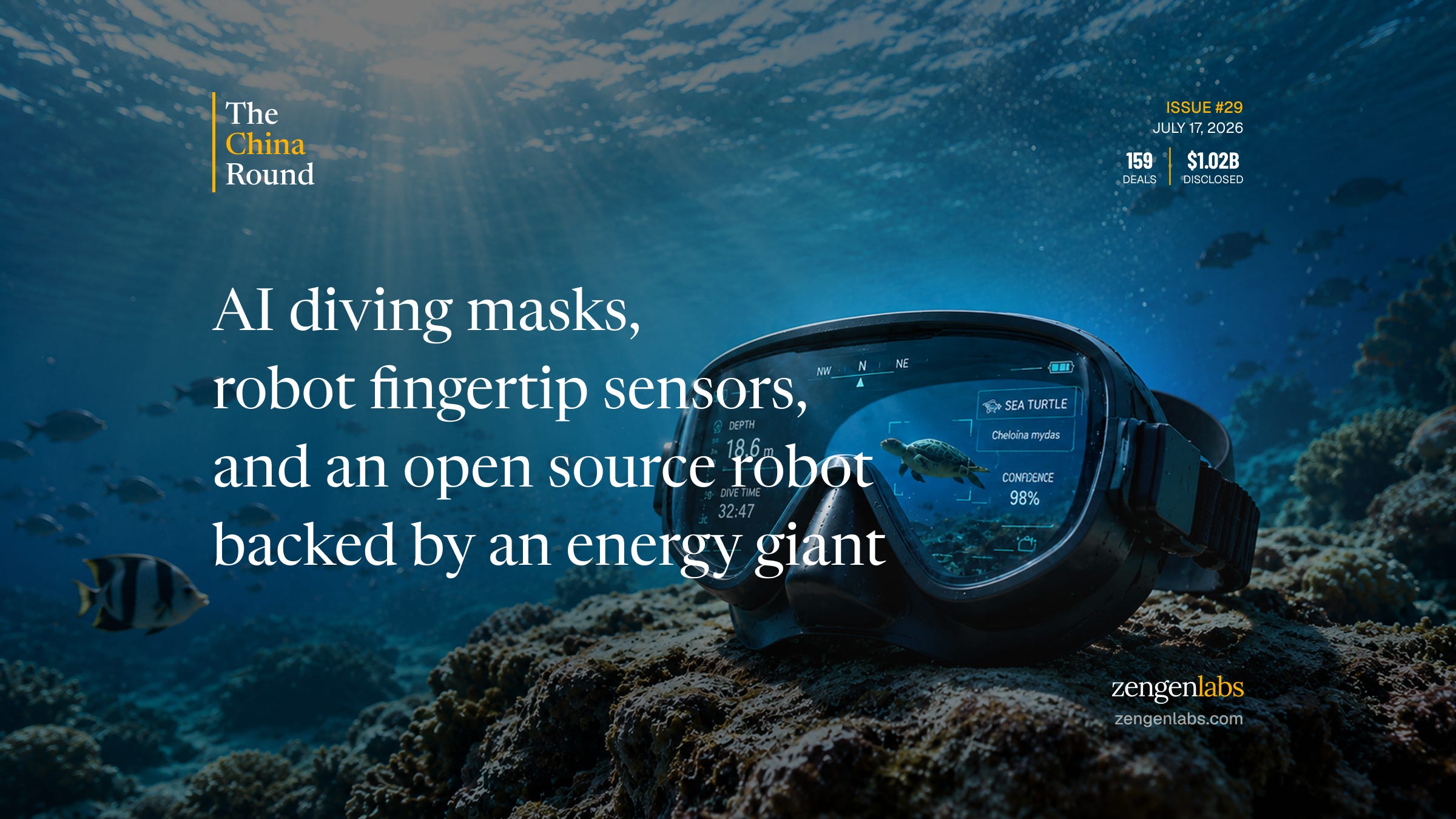
The China Round is a weekly report tracking venture and strategic investment activity across China’s core technology sectors: AI, robotics, semiconductors, new energy and materials, aerospace and defense, and frontier tech.
The China Round is free, published weekly, and written for investors, operators, and founders tracking where China’s tech capital is moving and why it matters.
About the author: Dermot McGrath is Irish, based in Shanghai, a decade in China’s tech and investment ecosystem, fluent Mandarin. Co-founded a VC fund scaled to nine-figure AUM. Now running ZenGen Labs, a cross-border strategy studio covering AI, robotics, and deep tech.
This is quite a few days late. I appreciate your patience. And fret not, there will be two editions this week. I was busy with WAIC and, more importantly, getting married.
The World AI Conference opened in Shanghai this week with Xi Jinping delivering the keynote, calling for open-source AI cooperation and pledging 5,000 AI training places for developing countries over the next five years. Ten days earlier, at a pre-WAIC press conference, the Ministry of Industry and Information Technology gave its most concrete production target yet for humanoid robots: 100,000 units in 2026, more than four times the roughly 24,000 deployed worldwide at the end of 2025.
Where the Money Went
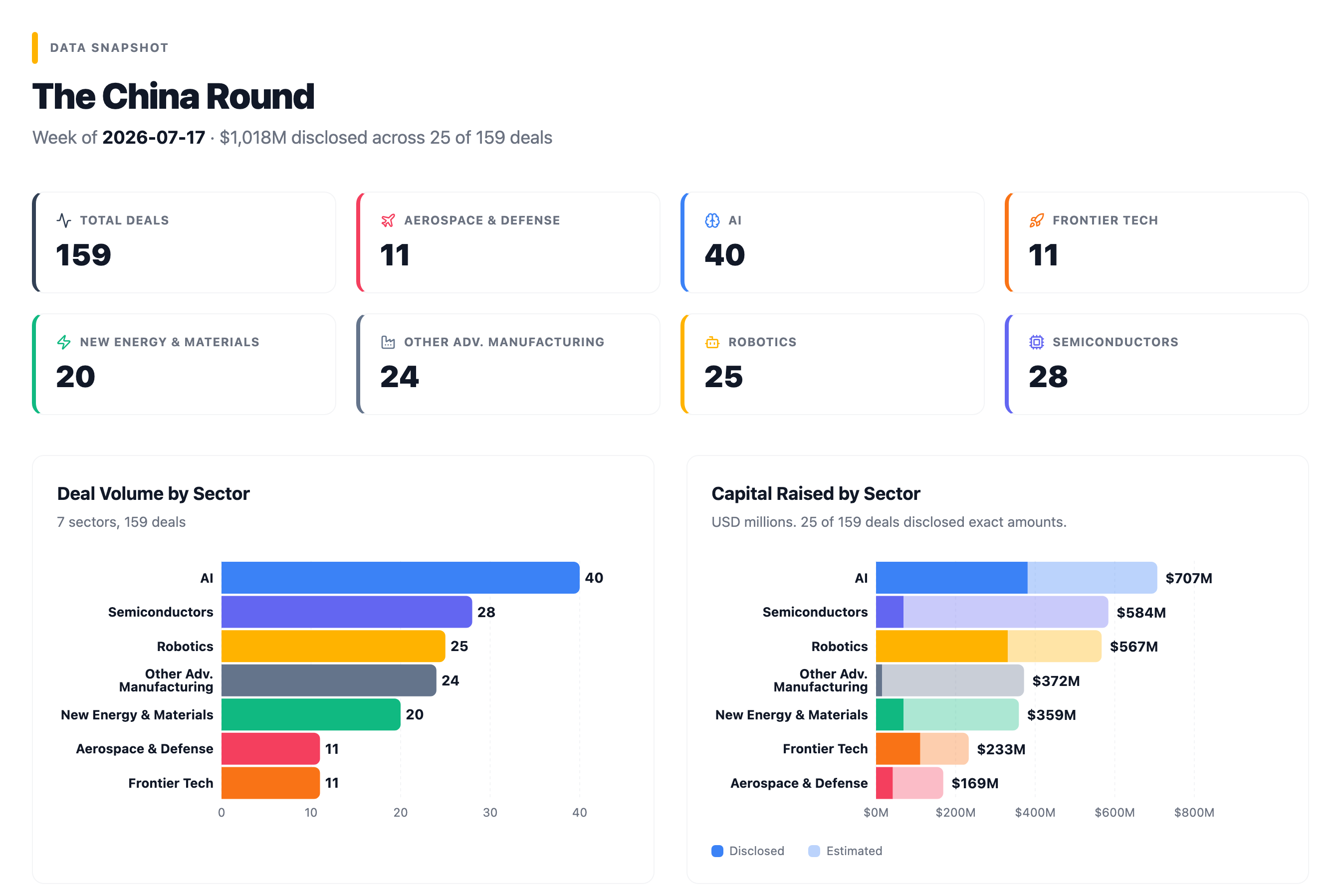
This week, 159 deals landed across seven sectors, and 25 of them disclosed a combined $1.02 billion (~¥7.3 billion). Most deals came without published figures, so the actual capital deployed was considerably higher. AI led in deal count with 40 transactions, followed by semiconductors (28), robotics (25), and other advanced manufacturing (24). Industrial customers, not venture funds, led several of the largest rounds this week, buying equity directly in the suppliers they need.
🧠 AI (40 deals)
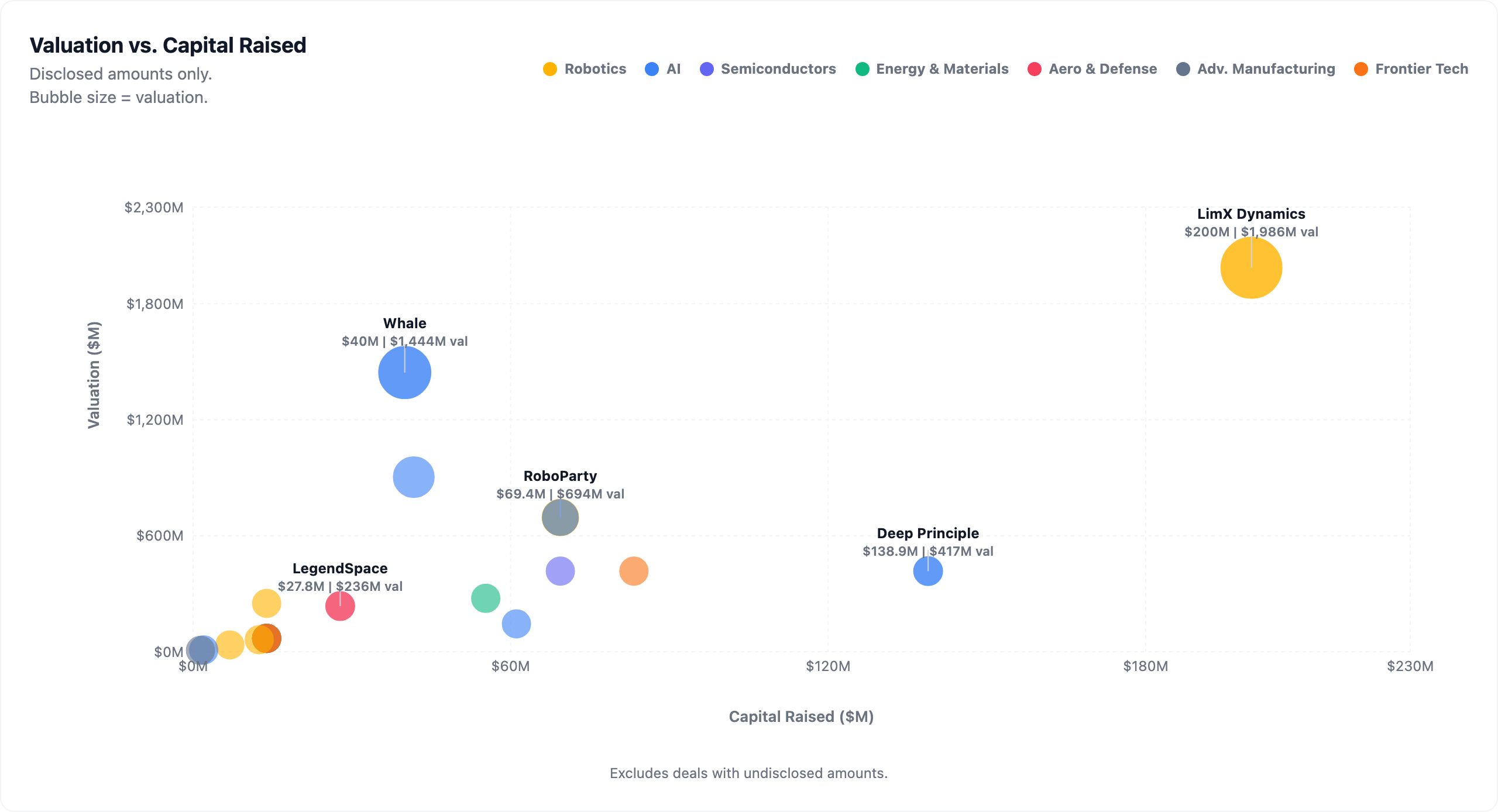
The two largest disclosed AI rounds went to on-device models, not cloud-scale foundation models: ModelBest (面壁智能) accumulated over ¥5 billion (~$694 million) across H1 2026 for models that run on phones and cars, and AIsphere (爱诗科技) closed its C+ at ¥2.98 billion (~$414 million) with Alibaba leading. TASHAN (他山科技) closed a B round with industrial customers as investors. At the early stage, seed and angel deals skewed toward embodied intelligence, with multiple rounds backing “world models” (AI systems that simulate physical cause-and-effect so a robot can predict what happens before it acts) and vision-language-action systems (models that turn a spoken instruction directly into physical movement).
⚡ New Energy & Materials (20 deals)
Power, batteries, and the physical infrastructure beneath the AI boom. Marvel-Tech (慕帆动力) closed a Sequoia-led C round for on-site AI datacenter power generation. ENN Fusion (新奥聚变) opened its first external round at ¥10.6 billion after more than a decade of internal R&D. Ganfeng Battery (赣锋锂电) raised twice in three weeks for solid-state batteries. Linkcharging (领充新能源) raised a strategic C round with multiple automakers. Generating, storing, and delivering power is becoming its own investment category, driven by AI compute demand.
🔬 Semiconductors (28 deals)
State-capital coalitions and strategic investors dominated. Liuyuewei (六岳微) raised ¥500 million in a Series A for domestically developed digital signal processors (the chips that convert real-world signals like sound and radar into digital data), backed by a Guangdong government coalition. Cygnusemi (星思半导体) completed its third round of 2026 for satellite baseband chips (the component in a phone or terminal that decodes wireless signals), reaching ¥12 billion. Shuoguang Precision (烁光精密) attracted two listed-company strategic stakes within weeks for co-packaged optics components, the light-based interconnects replacing copper inside AI data centers. Multiple deals showed listed companies taking direct equity in their own suppliers rather than routing through venture funds.
🤖 Robotics (25 deals)
Capital came from unusual directions. LimX Dynamics (逐际动力) raised $200 million in a Pre-IPO, over 70% from overseas investors. CATL took RoboParty’s (萝博派对) entire Pre-A alone. Shanghai Electric led DexRobot’s (灵巧智能) Series A and co-founded two manufacturing joint ventures with the company. Seven of 25 deals were at the angel stage, suggesting a new wave of company formation. Industrial companies are buying equity in their future robot suppliers, locking in components before the production ramp.
💡 Frontier Tech (11 deals)
The largest round came from one of the oldest companies: Wentian Quantum (问天量子) raised ¥600 million in a Series B after 17 years in quantum communication. Bama (八匹马) raised over ¥100 million for superconducting magnets (magnets cooled to near absolute zero to generate extremely strong magnetic fields) and cryogenics serving quantum computing, fusion, and semiconductor fabrication. Shuyanjuchuang (束研聚创) raised ¥100 million at the angel stage for neutral beam injection systems (equipment that shoots high-energy particles into a fusion reactor’s plasma to heat it enough to sustain a reaction). Two of three deals are component suppliers to other frontier sectors, a sign that the infrastructure layer beneath quantum and fusion is now investable on its own.
🚀 Aerospace & Defense (11 deals)
LegendSpace (临界航天), a six-month-old startup, raised ¥200 million (~$28 million) at the angel stage for AI-accelerated liquid rocket engine development. Galactic Energy (星河动力), China’s most-launched pre-IPO commercial rocket company with 21 flights and 89 satellites delivered to orbit, took an investment from GAC Capital, Guangzhou Automobile Group’s corporate venture arm. GAC Group launched its own flying car brand earlier this year and has backed autonomous driving companies including Momenta and Pony.ai, a portfolio that puts rocket launches closer to the core business than it first appears.
⚙️ Other Adv. Manufacturing (24 deals)
Hardware teams leaving big companies to build consumer products for export. Deeplore (蓝洞探索), three former DJI engineers, raised a seed for an AI diving mask. LightMake (轻量智造), a former AnkerMake lead, raised an angel for 3D printers targeting North America and Europe. Whale (帷幄) raised $40 million from Hyundai and Japanese bank corporate venture arms, bringing its total Series C to over $100 million, more than half its revenue now international. Chinese hardware expertise built at scale inside large companies is spinning out and shipping directly to Western customers.
Spotlight
Deeplore (蓝洞探索)
Seed, Tens of millions of RMB (several million USD), Val. ¥150M (~$21M)
AI diving mask with a heads-up display and real-time marine species recognition.