

The China Round — June 12, 2026
A brain-spine implant helps paralyzed patients walk, AI enters the garment factory, and film studios buy their way into AI

The China Round is a weekly report tracking venture and strategic investment activity across China’s core technology sectors: AI, robotics, semiconductors, new energy and materials, aerospace and defense, and frontier tech.
Where capital flows is where talent concentrates, where production capacity gets built, and where the next commercial technologies will come from.
The China Round is free, published every Friday, and written for investors, operators, and founders tracking where China’s tech capital is moving and why it matters.
About the author: Dermot McGrath is Irish, based in Shanghai, a decade in China’s tech and investment ecosystem, fluent Mandarin. Co-founded a VC fund scaled to nine-figure AUM. Now running ZenGen Labs, a cross-border strategy studio covering AI, robotics, and deep tech.
As this report went to press, China’s drug regulator accepted an IPO application from Neuracle (博睿康), the company behind the world’s first commercially approved invasive brain-computer interface. It filed for a ¥2.5 billion (~$347M) listing on Shanghai’s STAR Market, the tech-focused board that serves a similar role to Nasdaq for Chinese companies. That timing is coincidental, but the signal is not. China’s frontier medical devices are moving from lab to market to public listing faster than most investors expected.
Where the Money Went
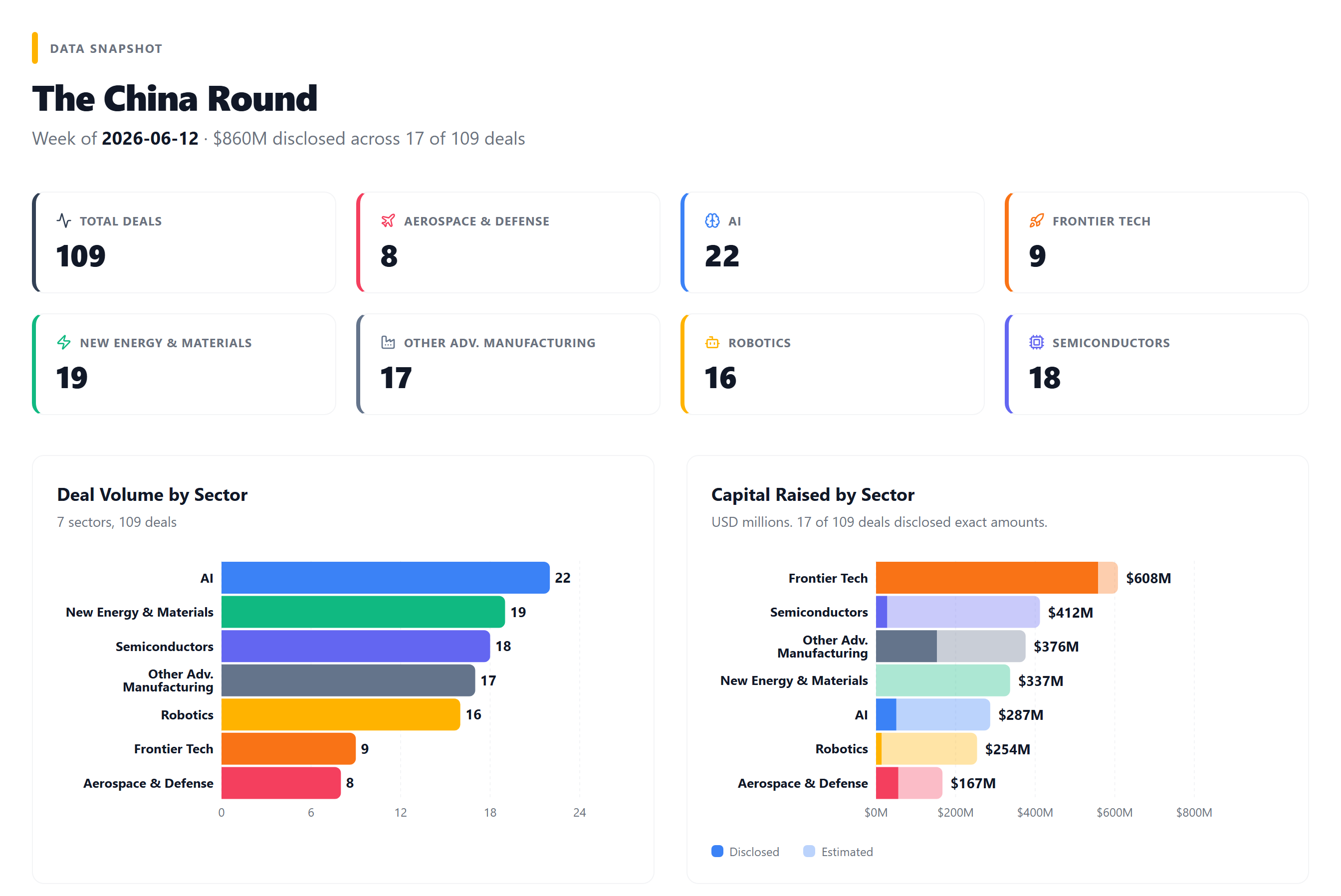
This week’s scan captured 109 deals across all sectors, with 27 additional stragglers from last week’s gap. Origin Quantum’s ¥3 billion (~$417M) quantum computing Pre-IPO dominated the headline numbers. Strip that out and 16 deals disclosed a combined ~$443M (~¥3.2B), a solid mid-tier week. Robotics and AI continued to lead deal volume, but the week’s most interesting stories came from frontier tech and advanced manufacturing.
🧠 AI (22 deals)
AI deal flow stayed strong at 22 rounds, though this week skewed toward application-layer companies rather than foundation models. The standout was CreativeFitting (井英科技), which closed both an A and A+ round backed by Ant Group for its overseas AI short drama app, Reel.AI. HiDream.ai (智象未来) received a strategic investment from Huace Film (华策影视), one of China’s largest private TV drama producers. A cluster of early-stage deals in spatial intelligence, AI education, and virtual humans filled out the sector.
⚡ New Energy & Materials (19 deals)
Materials and new energy logged 19 deals, almost entirely early-stage. MATTERENE (烯材科技), co-founded by Nobel laureate Andre Geim, raised a Pre-A+ from Aviation Industry Investment for its graphene film production facility in Shenyang. Advanced ceramics, specialty metals, and battery materials accounted for the bulk of deals, with state-backed funds leading most rounds.
🔬 Semiconductors (18 deals)
Semiconductor deal count held steady at 18. The week’s standout was Anatrix (安纳智芯), a six-month-old Peking University spinout whose RRAM analog computing chip earned a Nature Electronics paper and a Series A led by Matrix Partners China (经纬创投). Raysees (瑞识科技), the Samsung Galaxy Ring sensor supplier, took strategic capital from GAC at a ¥3.5 billion (~$486M) valuation. Wisewave (芯潮流), which designs the high-speed data link circuits that let chips inside servers and AI clusters talk to each other at hundreds of gigabits per second, raised a Series A from Sequoia China and CITIC Securities.
🤖 Robotics (16 deals)
Robotics logged 16 deals and produced some of the week’s biggest stories. Dexmal (原力灵机) closed a B round at ¥6 billion (~$833M) valuation backed by three of China’s top large language model companies: Zhipu AI, StepFun (阶跃星辰), and SenseTime. LiberAI hit a ¥3 billion (~$417M) valuation on a Pre-A. Inspire Robotics (因时机器人) raised a C+ at ¥2.6 billion (~$361M), having shipped over 10,000 dexterous hands in 2025. Qianjue Robotics (千诀科技) raised an A round at a ¥5 billion (~$694M) valuation for its robot decision-making and planning platform.
💡 Frontier Tech (9 deals)
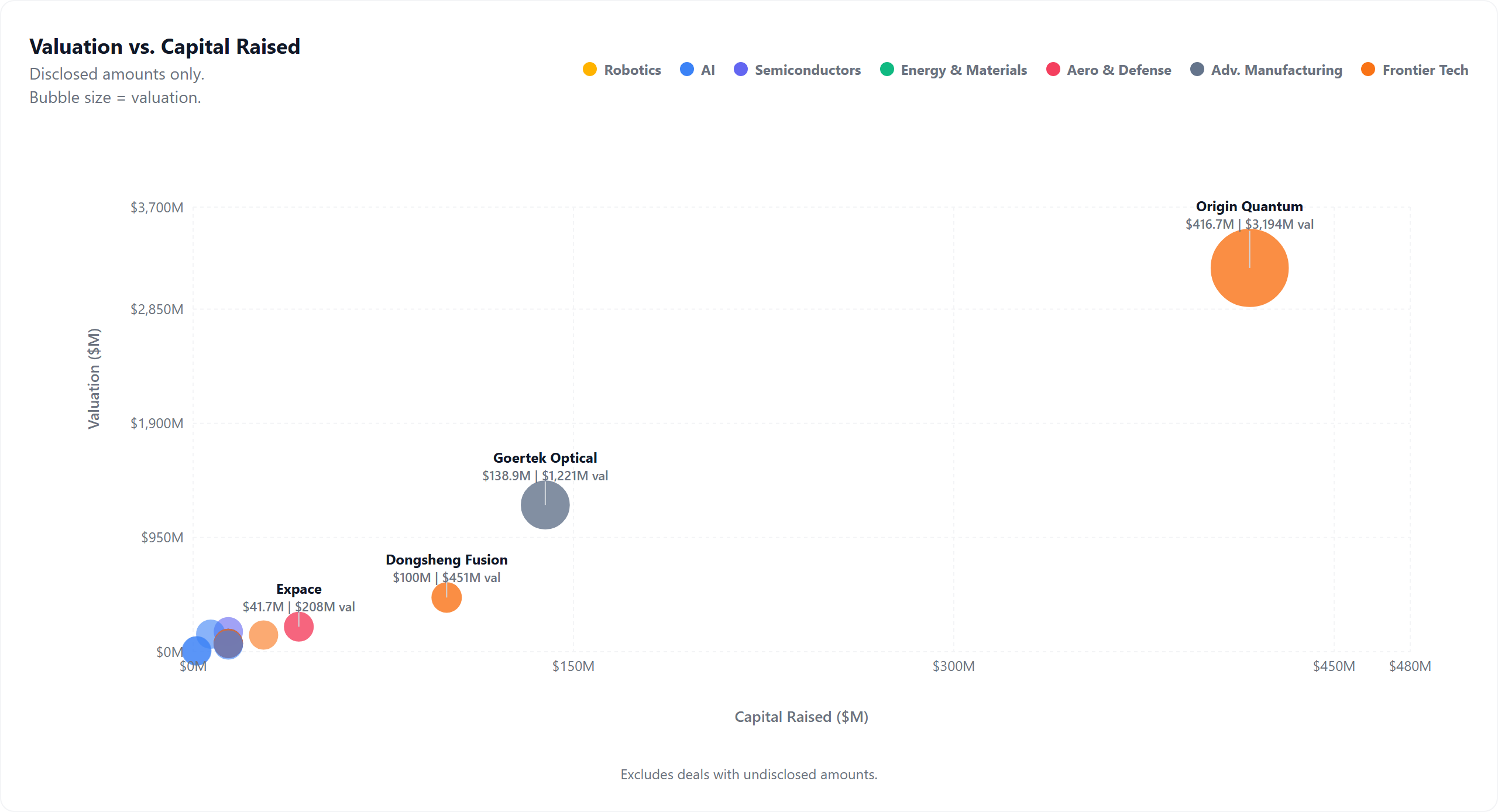
Frontier tech produced the week’s largest round and its strongest stories. Origin Quantum (本源量子) raised ¥3 billion (~$417M) in a Pre-IPO with China North Industries Group (中国兵器集团), a defense conglomerate, among the lead investors. A nuclear energy cluster formed: Dongsheng Fusion (东昇聚变) raised $100 million (~¥720M) to build a tokamak, a doughnut-shaped reactor that confines superheated plasma with magnetic fields to fuse hydrogen isotopes into helium, releasing energy. Its D-He3 fuel choice produces near-zero radioactive waste. Weilan Zhidian (蔚蓝支点) raised hundreds of millions of RMB for a small modular fission reactor, and straggler Dongxi Fusion (东曦聚变) raised hundreds of millions for a fusion approach that uses high-powered lasers to compress fuel pellets until they ignite. In BCI, Shenfu Jianxing (神复健行) raised ¥300 million (~$42M) at ¥1.8 billion (~$250M), the largest angel round in Chinese BCI history.
🚀 Aerospace & Defense (8 deals)
Eight aerospace deals, led by Expace (科工火箭), the commercial launch arm of state defense conglomerate CASIC, which raised ¥300 million (~$42M) in a C round. Tianmu Turbine (天目涡轮) raised a near-¥100 million (~$14M) angel for aviation engines, an unusually large angel for propulsion hardware.
⚙️ Other Adv. Manufacturing (17 deals)
Seventeen deals in optics, 3D printing, precision equipment, and factory automation. The headline was Goertek Optical (歌尔科技), which took ¥1 billion (~$139M) in strategic capital from parent Goertek and Sunny Optical at a ¥8.79 billion (~$1.22B) valuation, positioning for the AR/VR optics cycle.
Spotlight
Shenfu Jianxing (神复健行)
Angel, ¥300M+ (~$42M), ¥1.8B valuation (~$250M)
Implantable brain-spinal interfaces that help paralyzed patients walk again.
Shenfu Jianxing is a one-year-old Fudan University spinout building implantable devices that bridge the motor cortex to the spinal cord. Unlike Neuralink’s approach, which reads brain signals and sends them to external devices, Shenfu Jianxing’s implant creates an internal neural bridge: it captures movement intentions from the brain and delivers targeted stimulation to the spine, bypassing the injury site entirely. Think of it as rewiring the body’s own communication channel rather than routing it through a computer.
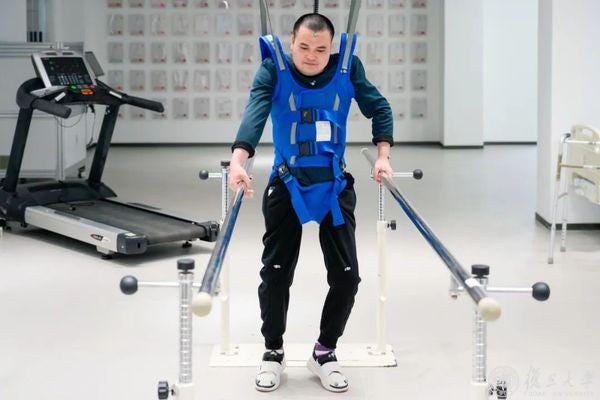
Between January and March 2025, the company implanted devices in four patients with complete spinal cord injuries. All four regained voluntary leg movement within 24 hours. The first patient, paralyzed for two years, walked independently within two weeks. In December 2025, the company received FDA Breakthrough Device Designation, the first Chinese brain-spinal interface company to secure this fast-track pathway. The clinical work was conducted with teams from Fudan’s affiliated Zhongshan and Huashan hospitals, two of China’s top medical centers. Lead researcher Jia Fumin is an associate researcher at Fudan’s Institute of Brain-Inspired Intelligence.
Per deal coverage, this is the largest angel round in Chinese BCI history, surpassing Gestala’s ¥150 million (~$21M) record set just three months earlier. The round was structured as a series of closings: Cathay Innovation (凯辉基金) led one tranche, while SDIC Pioneer (国投先导) and Sherpa Ventures (夏尔巴投资) co-led another. Hengxu Capital (恒旭资本) followed, and Fudan Science Innovation (复旦科创) added to its existing stake.
Dexmal (原力灵机)
B Round, Undisclosed, ¥6B valuation (~$833M)
Embodied AI models plus a logistics robotics subsidiary with real revenue.
Dexmal was founded in early 2025 by Tang Wenbin, co-founder and CTO of Megvii (旷视), along with three other Megvii veterans, all graduates of Tsinghua University’s Yao Class, an elite computer science program named after Turing Award winner Andrew Yao. The company builds embodied AI models, including DM0, a 2.4-billion-parameter universal embodied model open-sourced on HuggingFace, an open repository for AI models, with hardware designs (DOS-W1) published on GitHub.
What makes Dexmal structurally different from other embodied AI startups is its merger with Atomix (原力聚合), a Megvii spinout that builds logistics robotics. Atomix generates approximately ¥1 billion (~$139M) in annual revenue from over 500 projects across more than 20 countries, with clients including Uniqlo, CATL, and Mixue (蜜雪冰城). Most embodied AI startups have models. Dexmal has models, deployed robots, and international revenue.
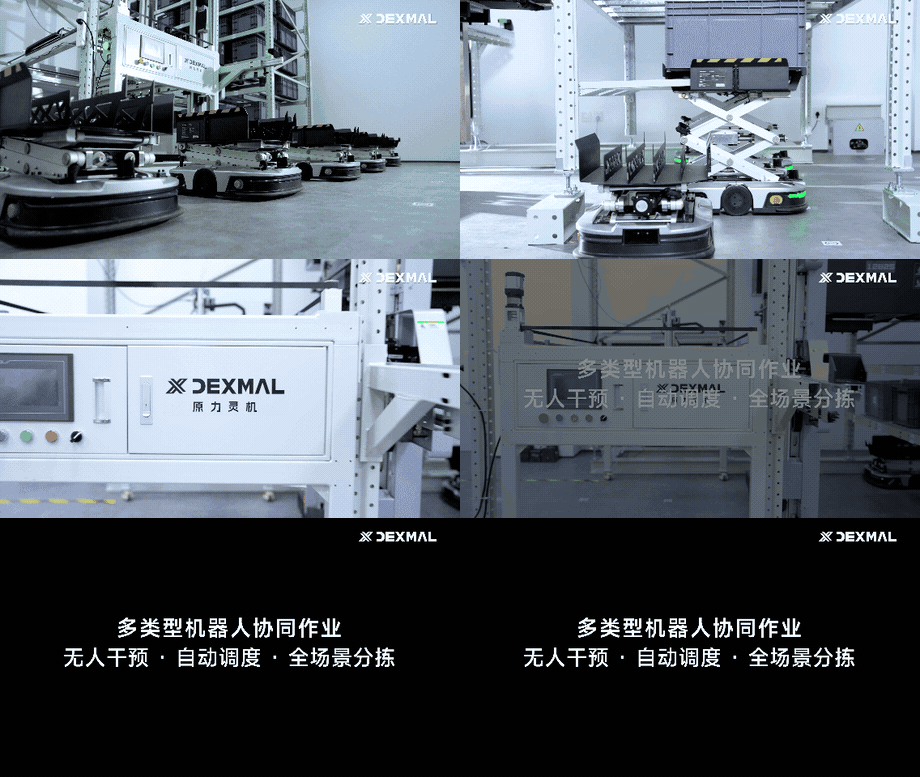
Four of China’s leading large language model companies have backed the company across its fundraising history: Zhipu AI, StepFun (阶跃星辰), and SenseTime invested in the B round, while Alibaba was the sole investor in the prior A+ round. Four competitors in the foundation model race, all concluding they cannot build physical AI alone and backing the same external infrastructure provider. Earlier rounds were led by Legend Capital (君联资本), Qiming Venture Partners (启明创投), and NIO Capital (蔚来资本).
Vector Spiral (向量螺旋)
Strategic Investment, Undisclosed, ¥500M valuation (~$69M)
AI models trained specifically for garment manufacturing supply chains.
Vector Spiral has built what it describes as China’s only registered vertical large language model for the apparel industry. The company’s AI links fabric microscopy photos, design sketches, production specifications, and on-model photography into a single data chain that creates a shared language between raw material suppliers, fabric mills, garment factories, and brands. The practical result: a brand can upload a sketch, and the system generates 360-degree on-model product views that preserve fabric texture across every angle, a capability general-purpose image generators cannot reliably deliver.
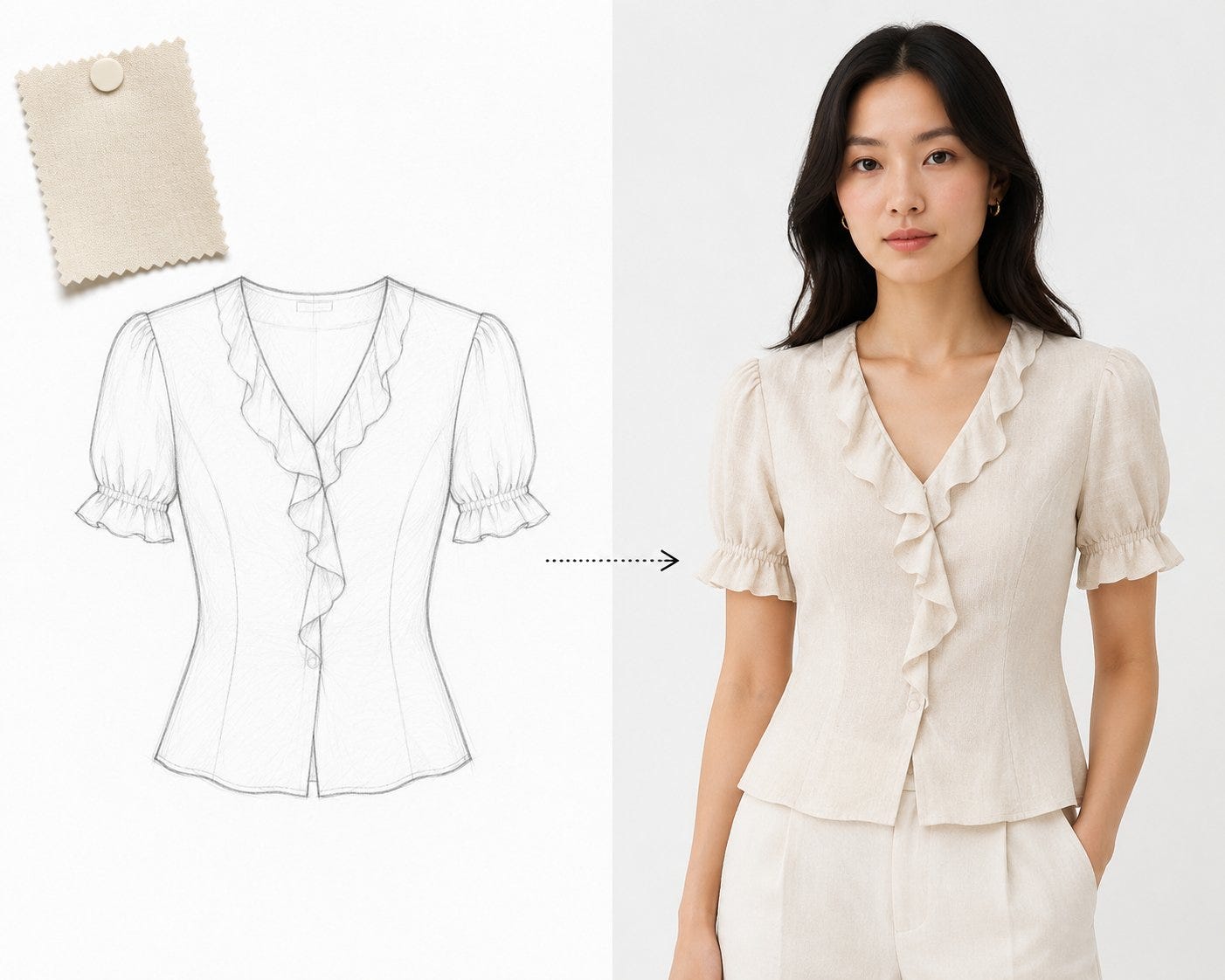
The company entered Japan first, deliberately choosing a market where data quality is high and government AI subsidies made enterprise adoption easier. It now counts hundreds of Japanese enterprise clients and has entered the supply chain of Shenzhou International (申洲国际), one of the world’s largest vertically integrated knitwear manufacturers and supplier to Nike, Adidas, and Uniqlo. In a $3 trillion global garment industry that remains one of the least digitized, Vector Spiral is betting that AI can do more than generate pretty images. It can become the communication layer between every node in the supply chain. Qingdao Science Innovation Fund (青岛科创母基金) led this round.
Anatrix (安纳智芯)
Series A, Hundreds of Millions RMB, ¥800M valuation (~$111M)
Analog computing chips that sidestep the US chip embargo.
Most chips work by converting everything into ones and zeros and crunching through the math step by step. Anatrix takes a different approach: its chips store and process data at the same time, in the same place, by using tiny variations in electrical resistance to represent values directly. Think of it as the difference between reading a recipe one line at a time versus seeing the whole page at once. The result is much faster math on specific workloads, at a fraction of the power. The underlying technology is called RRAM (resistive random-access memory), a type of analog computing that has been a research topic for years but has struggled to reach the precision needed for real-world use.
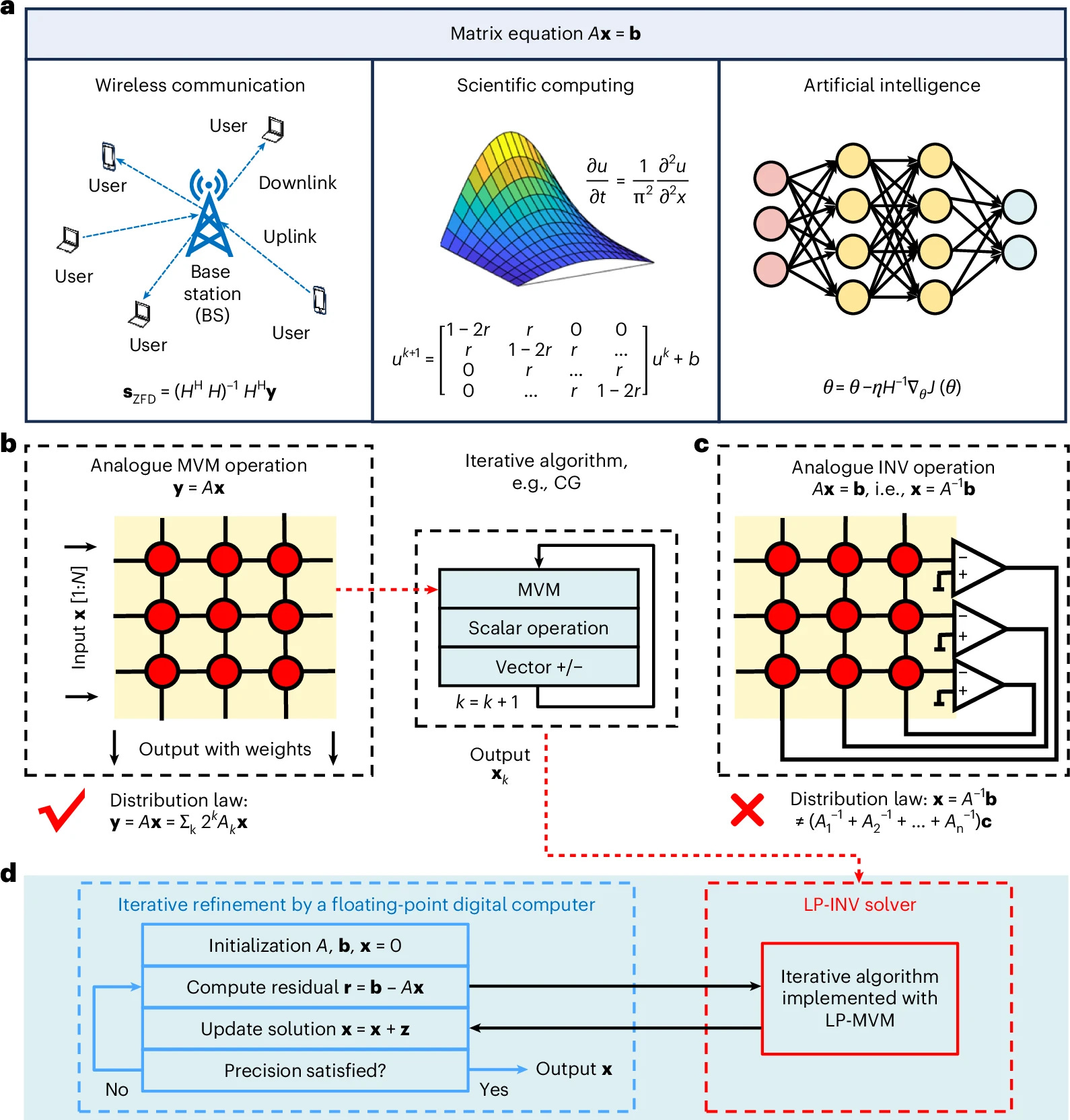
In October 2025, the team published a paper in Nature Electronics showing their chip had reached a level of numerical precision (24-bit fixed-point, comparable to the 32-bit floating-point used in standard computing) that was previously considered impossible for analog chips. On a benchmark test involving the kind of parallel math that 5G base stations and AI training clusters rely on, the chip outperformed GPUs including Nvidia’s H100 by over 1,000x in throughput.
The chip runs on a 40nm process node, a mature manufacturing technology that requires no extreme ultraviolet lithography, the most advanced (and export-controlled) chipmaking equipment. That puts it well outside the scope of US restrictions on semiconductor equipment sales to China. The company was founded in approximately December 2025 by Sun Zhong, a researcher at Peking University’s Institute for Artificial Intelligence, making it roughly six months old at the time of this raise. Matrix Partners China (经纬创投) led the round, with Frees Fund (峰瑞资本) and Alpha Commune (阿尔法公社) as co-investors. iFlytek Ventures (讯飞创投) reinvested from a prior seed round.
MATTERENE (烯材科技)
Pre-A+, Undisclosed
A Nobel laureate’s graphene factory, now backed by aerospace capital.
MATTERENE was founded in 2017 by a team led by Andre Geim, co-discoverer of graphene and 2010 Nobel Prize in Physics laureate, and Cheng Huiming (成会明), a Chinese Academy of Sciences Academician and chief scientist at CAS’s Shenzhen Institute of Advanced Technology. The company makes graphene conductive powders, heat dissipation films, and graphene oxide for applications in batteries, electronics thermal management, and advanced coatings.
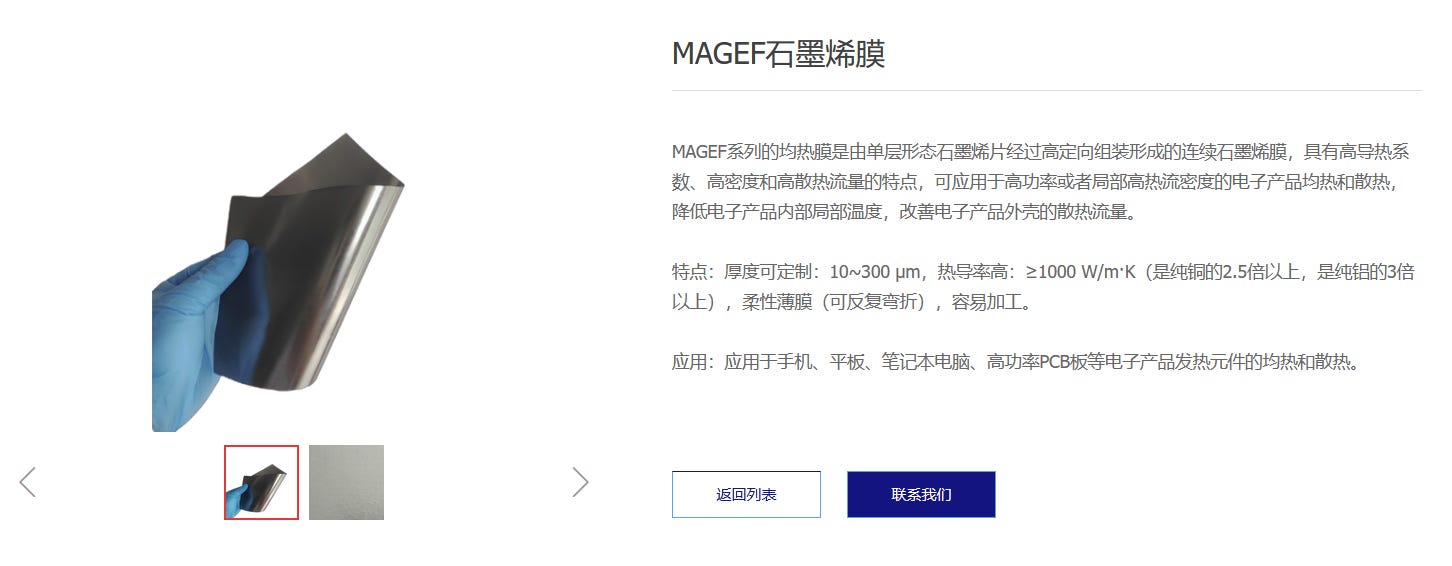
In August 2023, MATTERENE opened China’s first production facility for ultra-100-micron high-performance graphene films in Shenyang’s Hunnan Science and Technology City. At full capacity, the facility is projected to generate over ¥600 million (~$83M) in annual output. Graphene has been a laboratory material for two decades, with countless papers and few factories. MATTERENE is attempting to close that gap by turning a Nobel Prize discovery into industrial-scale production.
This round was led by Aviation Industry Investment (航空产业投资), a fund connected to China’s state aerospace sector. The aerospace interest signals that graphene’s thermal and conductive properties are finding applications in aircraft and satellite systems, not just consumer electronics. The prior Pre-A round in September 2023 was led by Guohua Investment (国华投资).
CreativeFitting (井英科技)
A + A+ Rounds, Tens of Millions USD Combined, ¥650M valuation (~$90M)
An AI short drama app built for overseas audiences, backed by Ant Group.
CreativeFitting builds Reel.AI, a mobile app that generates serialized short dramas using AI. The app is live on both iOS and Google Play, with distribution across Europe, Southeast Asia, Latin America, and the Middle East. The company was built explicitly for overseas markets from day one, targeting the short-form drama format that has exploded in popularity globally.

The founding team comes from TouchPal (触宝科技), a Chinese keyboard and input technology company that went public in the US. CEO Zhu Jiang previously served as TouchPal’s Chief Growth Officer. The company has raised six rounds since its 2021 seed from ZhenGe Fund (真格基金), with Baidu investing in a Pre-A+ round in July 2024. Ant Group backed both the A and A+ rounds closed in June 2026, alongside Lollapalooza Capital and individual investor Yin Yu (殷宇).
Can AI-generated serialized content sustain paying audiences, or is it a novelty? CreativeFitting’s fundraising velocity (six rounds in under five years, two in one month) suggests investors are betting the production economics work. AI-generated short dramas cost a fraction of human-produced equivalents while scaling to any language and any market simultaneously.
Origin Quantum (本源量子)
Pre-IPO, ¥3B (~$417M), ¥23B valuation (~$3.2B)
China’s largest quantum computing round, led by a defense conglomerate.
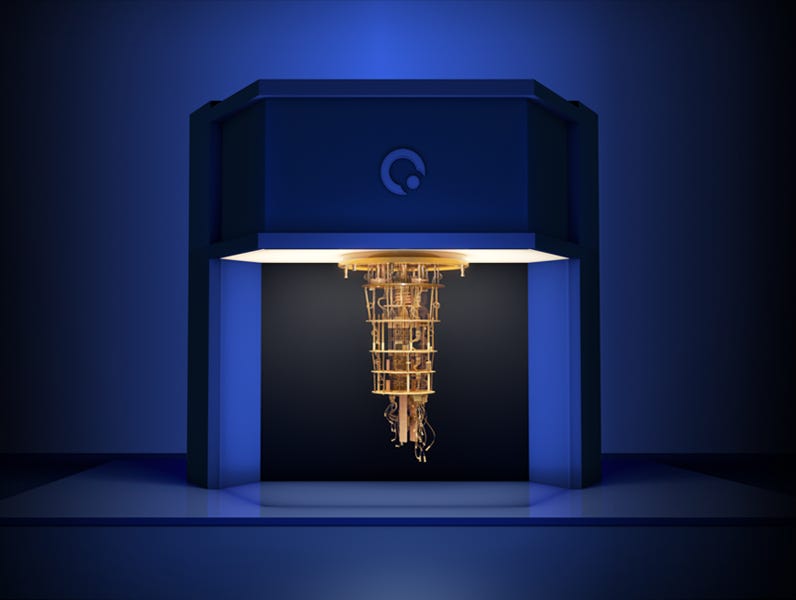
Origin Quantum was founded in 2017 by professors Guo Guoping (郭国平) and Guo Guangcan (郭光灿) at the University of Science and Technology of China (USTC) in Hefei. The company’s fourth-generation quantum computer, Origin Wukong-180, features 180 computational qubits with error rates below 1% on two-qubit operations, a threshold that determines whether a quantum computer can run useful calculations or just demonstrate that it works. Its cloud platform has been accessed from over 160 countries, completing more than 900,000 quantum computing tasks. In late 2024, Origin became the first Chinese company to commercially export quantum computing power.
China North Industries Group (中国兵器集团, also known as NORINCO), a central state-owned defense conglomerate, led the round, contributing ¥500 million (~$69M) of the ¥3 billion raise. China Minmin Investment (华民投) was among the new investors, alongside provincial and municipal government platforms. The defense lead makes the dual-use classification explicit. The company began formal IPO preparation for the STAR Market in September 2025, with CITIC Securities Construction Investment (中信建投) as underwriter.
For context, Quantinuum began trading on Nasdaq on June 4, at a valuation of approximately $14 to $15.7 billion after raising $1.68 billion. Origin’s ¥23 billion (~$3.2B) post-money is roughly a fifth of Quantinuum’s market cap, but Origin is generating revenue from enterprise customers including Ping An Bank and China Southern Power Grid, and is further along the path to public listing in its home market.
Also on the Radar
Nuclear cluster:
Dongsheng Fusion (东昇聚变), Pre-A, $100M (~¥720M), ¥3.25B val (~$451M). Tokamak fusion using D-He3 fuel, a fuel choice that produces near-zero radioactive waste. Angel to $100M in six months, with nine investors including CMC Capital, Qiming Ventures, and Huajin Capital co-leading. Fudan Modern Physics team. Announcement
Weilan Zhidian (蔚蓝支点), Pre-A, hundreds of millions RMB, ¥2B val (~$278M). Small modular nuclear reactor using pressurized water reactor technology, the most proven nuclear approach with over 70 years of operational history. Founded by Hu Po (胡珀), Tsinghua nuclear engineering. CDH Investments and Sequoia China in the round. Announcement
Dongxi Fusion (东曦聚变), Angel (straggler), hundreds of millions RMB, ¥1.5B val (~$208M). Described in Chinese press as China’s first private company pursuing laser-driven fusion, which uses high-powered lasers to compress fuel pellets until they ignite. CAS Star (中科创星) led, having also led Dongsheng Fusion, deliberately hedging across fusion approaches.
Other notables:
LiberAI, Pre-A, hundreds of millions RMB, ¥3B val (~$417M). Embodied AI models built by a young Tsinghua team. Demonstrated dexterous manipulation tasks (banana peeling, bottle caps, pan-frying) within four months of founding. Shunwei Capital (顺为, Lei Jun’s fund) led, with Cathay Innovation (凯辉基金) following.
Inspire Robotics (因时机器人), C+, undisclosed, ¥2.6B val (~$361M). Shipped over 10,000 dexterous robot hands in 2025, up from roughly 2,000 in 2024. Its components were on robots that performed at the 2026 CCTV Spring Festival Gala. More on the dexterous hand price collapse in The Bigger Picture below.
Phoskey (光子精密), Strategic, ¥100M (~$14M), ¥500M val (~$69M). A 13-year-old sensor and automation company that has taken only two VC rounds in its entire history. Serves approximately 70 Fortune 500 clients across 70+ countries. CICC Capital (中金资本) co-led, a typical signal of IPO trajectory.
HiDream.ai (智象未来), Strategic investment from Huace Film (华策影视), ¥6B val (~$833M). Visual AI model company based in Hefei. In its April 2026 funding round (¥500M+ / ~$69M+), the company reported 30 million professional users globally and said Q1 2026 revenue exceeded full-year 2025, per company disclosures.
Grace Investment Machine, Angel, ¥100M (~$14M), ¥500M val (~$69M). Financial AI reasoning engine built by a team including a co-founder with a PhD from Oxford and experience at DeepMind and Meta FAIR. SAIF Partners (赛富投资基金) led.
Goertek Optical (歌尔科技), Strategic, ¥1B (~$139M), ¥8.79B val (~$1.22B). Optoelectronic devices subsidiary of Goertek (歌尔股份), now taking strategic capital from both parent Goertek and Sunny Optical (舜宇光学) to position for the next AR/VR optics cycle.
Cliberd (微眸医疗), Series A, ~¥100M (~$14M), ¥500M val (~$69M). Ophthalmic surgical robot. Per the company, it completed the world’s first 5G remote robot-assisted injection into the back of the eye, performed across 4,200km (Guangzhou to Xinjiang). Multicenter randomized controlled trial completed; submission to China’s National Medical Products Administration (NMPA) for device approval imminent.
Expace (科工火箭), C Round, ¥300M (~$42M), ¥1.5B val (~$208M). The commercial launch subsidiary of CASIC (中国航天科工), one of China’s two main state aerospace conglomerates. Changjiang Capital (长江资本) led.
Wisewave (芯潮流), Series A (straggler), hundreds of millions RMB, ¥1.5B val (~$208M). Designs the high-speed data link circuits that connect chips inside servers and AI clusters. Sequoia China and CITIC Securities Capital (中信建投资本) co-led.
The Bigger Picture
Entertainment Companies Are Buying AI Model Equity, Not Licensing
A pattern is forming across this week’s deals and recent rounds that goes beyond the usual “AI partnership” press release. China’s entertainment companies are taking equity stakes in AI model companies, not just signing licensing agreements.

This week, Huace Film (华策影视, 300133.SZ), one of China’s largest private TV drama producers, made a strategic investment in HiDream.ai (智象未来) at a ¥6 billion (~$833M) valuation. Ant Group backed CreativeFitting (井英科技) across two rounds for Reel.AI, an AI-generated short drama app targeting overseas audiences. These follow a string of confirmed deals: Huace previously invested ¥100 million (~$14M) in Zhipu AI to jointly develop AI film tools. In January 2026, China Literature’s parent China Ruyi (中国儒意, 00136.HK) invested $14.2 million (~¥102M) in AISphere (爱诗科技), maker of PixVerse, which has over 100 million registered users globally. Hubei Changjiang Film Group (湖北长江电影集团) invested in HiDream.ai’s A round.
Licensing gives you access to today’s model. Equity gives you influence over tomorrow’s model, priority access to fine-tuning, and a seat at the table when training data and content rights get negotiated. For listed entertainment companies facing secular decline in traditional production, an AI model stake is both a hedge against disruption and an option on an entirely new production paradigm where content scales to any language at near-zero marginal cost.
China Medtech at a Fraction of Western Pricing, Now Seeking Western Approval
Two deals this week illustrate a pricing gap that investors in medical technology should pay attention to.
Shenfu Jianxing raised ¥300 million (~$42M) at a ¥1.8 billion (~$250M) valuation for a brain-spinal interface that has already made paralyzed patients walk and holds an FDA Breakthrough Device Designation. Neuralink’s most recent valuation was approximately $9 billion (~¥65B) from its June 2025 Series E. Shenfu Jianxing is valued at roughly one-thirty-sixth of Neuralink, despite having more advanced clinical results in motor function restoration.
On the same day, Neuracle (博睿康) had its STAR Market IPO application accepted, seeking to raise ¥2.5 billion (~$347M). Neuracle holds the world’s first NMPA registration for an invasive BCI medical device, a regulatory approval from China’s National Medical Products Administration, granted in March 2026. Its most recent private valuation was approximately ¥3.5 to 4 billion (~$500-556M), and it generated ¥108 million (~$15M) in revenue in 2025. Neuralink has not disclosed revenue and has no commercial regulatory approval in any market.
The discount extends beyond BCI. Cliberd (微眸医疗) raised approximately ¥100 million (~$14M) for an ophthalmic surgical robot. ForSight Robotics, an Israeli company building in the same surgical robot category, raised $125 million (~¥900M) in a Series B in June 2025, bringing total funding to $195 million (~¥1.4B). Chinese medical device companies are raising at a fraction of Western equivalents while pursuing the same regulatory pathways. As Chinese medical devices increasingly secure FDA clearance, and companies like Shenfu Jianxing obtain FDA Breakthrough Device Designation, this pricing gap may not persist.
The Robot Supply Chain Is Splitting Into Specialized Layers
This week’s robotics deals make visible a structural shift that has been forming for months: China’s embodied AI industry is not consolidating into vertically integrated companies. It is splitting into specialized layers, much like the PC industry did in the 1990s when IBM, Intel, and Microsoft each owned different parts of the stack.
The “brain” layer: Qianjue Robotics (千诀科技) raised an A round at a ¥5 billion (~$694M) valuation for a robot decision and planning model projected to be deployed on 100,000 devices by the end of 2026. The company’s architecture separates the “cerebrum” (high-level planning) from the “cerebellum” (motor execution), a framing that China’s Ministry of Industry and Information Technology has adopted as official policy language for the sector.
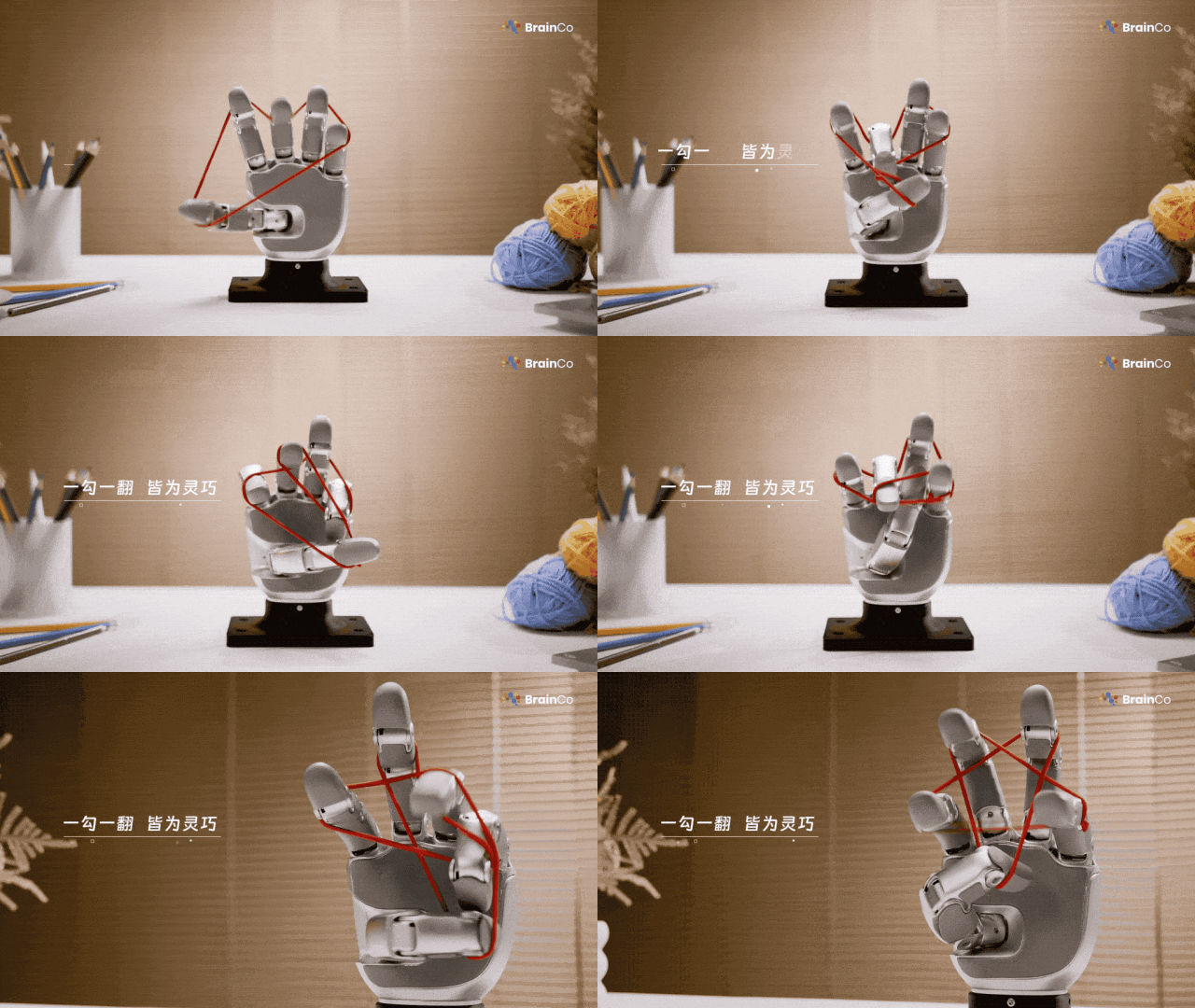
The “hands” layer: Inspire Robotics (因时机器人) shipped over 10,000 dexterous robot hands in 2025, up from roughly 2,000 the year before. BrainCo (强脑科技), originally a brain-computer interface company, launched its Revo 3 hand in April 2026 with 21 degrees of freedom and full-palm tactile sensing. Per Bloomberg, dozens of robotics firms including Unitree are now buying BrainCo’s hands. A dexterous hand from UK-based Shadow Robot has historically cost over ¥1 million (~$139K) per unit. Chinese manufacturers have collapsed that price by two orders of magnitude: LinkerBot (灵心巧手) now offers an entry model at ¥8,800 (~$1,200), and according to company claims, ships over 1,000 units per month.
The “platform” layer: Dexmal (see Spotlight) merged with logistics robotics subsidiary Atomix, gaining ¥1 billion (~$139M) in annual revenue across 20+ countries. Rather than building its own hands or planning models, it is positioning as the integration layer between them.
Betting on “the robotics winner” may be the wrong frame. The question is which layer captures the most value, and whether the brain companies, the component companies, or the platform companies end up with the pricing power.
Deal data compiled from Chinese corporate announcements, financial news, and investment databases. Amounts and valuations are as reported and may be incomplete. For informational purposes only. Not investment advice. Verify all figures independently before acting on them.