


The China Round is a weekly report tracking venture and strategic investment activity across China’s core technology sectors: AI, robotics, semiconductors, new energy and materials, aerospace and defense, and frontier tech.
Where capital flows is where talent concentrates, where production capacity gets built, and where the next commercial technologies will come from.
The China Round is free, published every Friday, and written for investors, operators, and founders tracking where China’s tech capital is moving and why it matters.
About the author: Dermot McGrath is Irish, based in Shanghai, a decade in China’s tech and investment ecosystem, fluent Mandarin. Co-founded a VC fund scaled to nine-figure AUM. Now running ZenGen Labs, a cross-border strategy studio covering AI, robotics, and deep tech.
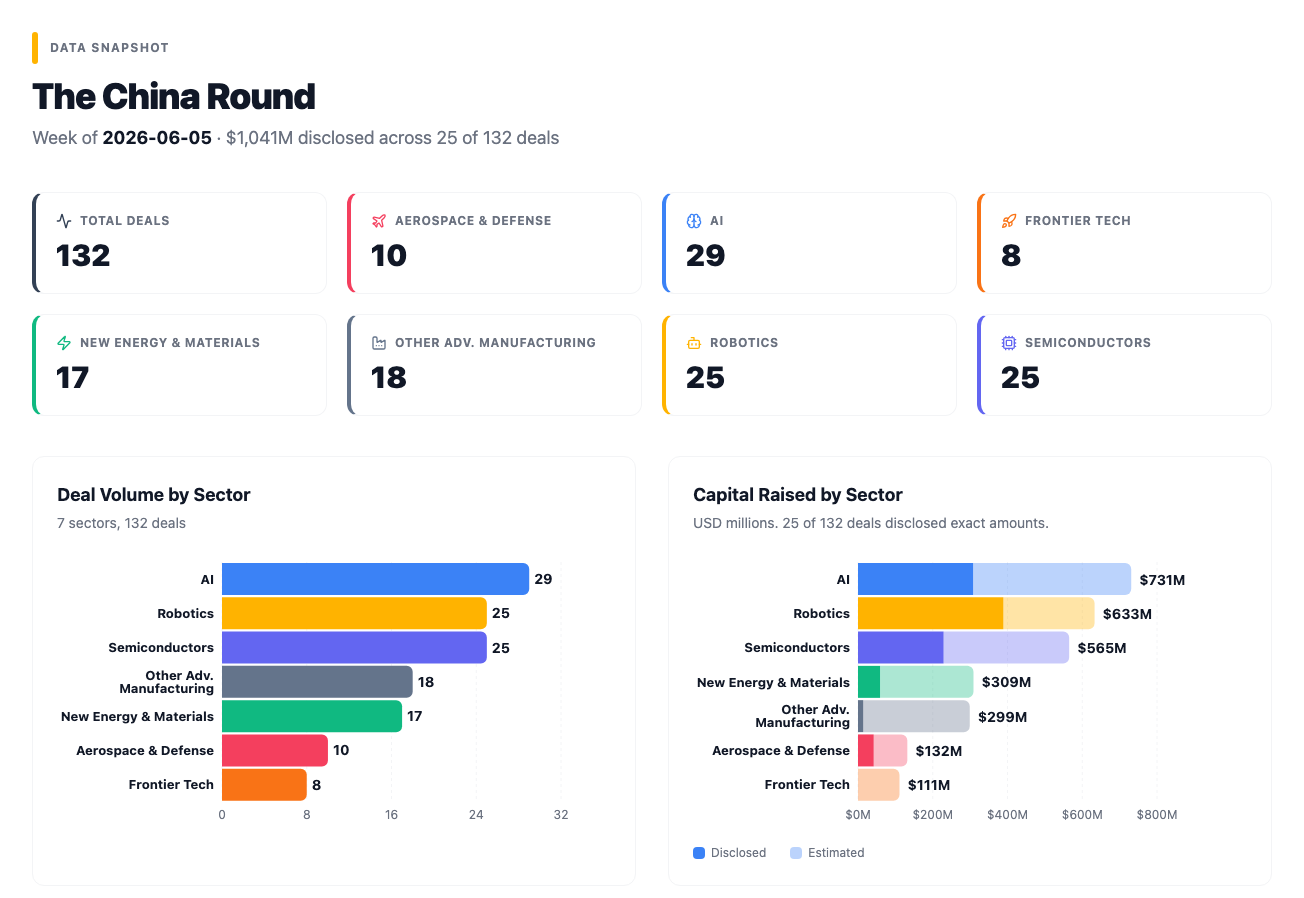
This was one of the busiest weeks of the year, with 132 deals in seven days. Two humanoid robot unicorns, a $200 million 3D AI round, and a wave of quantum deals backed by something closer to industrial policy than venture capital.
Where the Money Went
132 deals crossed the wire this week. About half published some indication of the amount raised, with 25 deals disclosing exact figures for a combined total of ~$1 billion (~¥7.5 billion). The real figure is substantially higher: most early-stage Chinese rounds never publish an amount, so treat that as a floor. The biggest individual checks went to humanoid robotics, but the broader story is breadth: every sector had at least eight active deals, and several had more than twenty.
🧠 AI (29 deals)
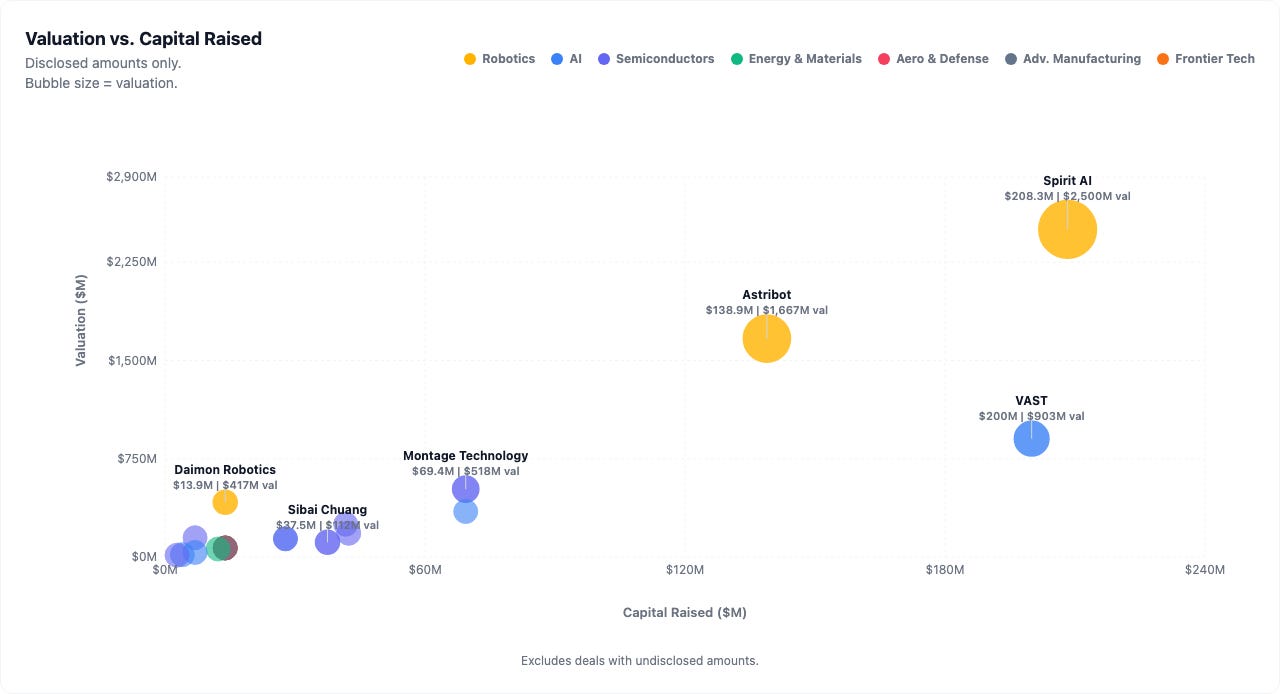
AI led the week by deal count, anchored by two outsized rounds. VAST (also known as Tripo AI) raised $200 million (~¥1.44B) for its 3D AI foundation model, while LightLink Tech (光联芯科) raised ¥500 million (~$69M) for optical chip-to-chip interconnect, a technology that replaces the copper wires between processors with laser light to keep up with AI compute demands. The rest of the sector split between AI agents, life science automation, and data infrastructure. Several deals went to companies building the training data that physical AI systems need: embodied intelligence is generating its own supply chain.
⚡ New Energy & Materials (17 deals)
Battery materials and energy storage continued their quiet grind. No single blockbuster, but steady capital into cathode and anode materials, lithium-ion cell makers, and advanced-materials plays. The largest disclosed amounts were modest: ¥140 million (~$19M) for a flexible photovoltaic company and ¥88.2 million (~$12M) for a lithium iron phosphate subsidiary. The sector’s capital arrives incrementally, round after round, without the headline figures that robotics and AI command.
🔬 Semiconductors (25 deals)
The second-busiest sector and the most strategically dense. A subsidiary of chip-design house Montage Technology (澜起科技) raised ¥500 million (~$69M) for switch chips that control how processors and memory share data inside an AI data center, the routing layer that determines whether thousands of chips work together efficiently or spend most of their time waiting on each other. Supercore (超摩科技) raised ¥305 million (~$42M) for processors built from smaller, stackable tiles rather than one large chip, a design that lets manufacturers match high-end performance using fabrication processes they have access to domestically. LEDA Tech (立芯软件) took ¥300 million (~$42M) for EDA tools, the software engineers use to design chips before fabrication. And at the other end of the spectrum, Sibai Chuang (偲百创) was acquired at a distressed valuation by listed RF chipmaker Wisecore for vertical integration. The stage distribution skewed early, with several angel and Pre-A rounds targeting advanced chip packaging, processors that compute directly inside memory chips, and display semiconductors.
🤖 Robotics (25 deals)
The biggest individual checks of the week. Spirit AI (千寻智能) raised ¥1.5 billion (~$208M) at a ¥18 billion (~$2.5B) valuation, its sixth round in twelve months. Astribot (星尘智能) closed a ¥1 billion (~$139M) Series B at ¥12 billion (~$1.67B). Below those flagships, capital concentrated in components and data rather than finished machines: dexterous hands, tactile sensors, force-torque sensors, tendon-drive mechanisms, and the training data that teaches robots to manipulate real objects all drew more rounds than complete humanoid systems.
💡 Frontier Tech (8 deals)
Eight deals, three of them quantum. HyQubit (华翊量子) raised its A+ from a 10-investor national syndicate for quantum computers that trap individual atoms with lasers to perform calculations. FieldQuantum (量坤科技), a five-month-old quantum-AI middleware company with no product, raised hundreds of millions at a ¥1.8 billion (~$250M) valuation. GGQuanta (国光量子) completed its third round in three months from industrial and strategic listed companies. The non-quantum deals included two brain-computer interface startups and a simulator for modeling nuclear fusion reactions.
🚀 Aerospace & Defense (10 deals)
Satellite communications, eVTOL (electric vertical-takeoff aircraft, essentially flying taxis), and space. Interstellor (穿越者) raised ¥100 million (~$14M) for crewed spacecraft that fly to the edge of space and return without entering orbit, a market aimed at space tourism and high-altitude research. SparkSpace (星火空间) took a Pre-A for liquid rockets that use electric motors to feed propellant rather than traditional turbopumps, a simpler design suited to small satellite launches. The rest was early-stage: satellite-based Earth observation, rocket propellant tanks, and UAVs. Disclosed aerospace capital was modest, about $28 million (~¥200M), but the deals are concentrated in hardware categories that take years and billions to reach scale.
⚙️ Other Adv. Manufacturing (18 deals)
The catch-all sector, and this week mostly components. Kunwei Technology (坤维科技) raised ¥100 million (~$14M) for six-axis force-torque sensors, the kind of touch-sensitive joint that lets a robot arm know exactly how hard it is pressing and adjust in real time. Servo systems, fiber-optic temperature sensors, and industrial automation filled out the list. Stage distribution was scattered: from angel rounds for polishing robots to a Series D for an optical sensing company.
Spotlight
Spirit AI (千寻智能)
A+, ¥1.5 billion (~$208M), ¥18 billion (~$2.5B) valuation
The humanoid robot company that beat global benchmarks and raised nearly ¥5 billion in three months.