


WEIBUILD (蔚建科技) builds robots for jobs you’d usually call a plasterer or painter to do. One applies mortar and levels it, another spray-paints walls and ceilings. The Shanghai company says it used one of its sprayers to paint a ceiling at NS Square, a 30,000-seat waterfront venue under construction at Singapore’s Marina Bay.
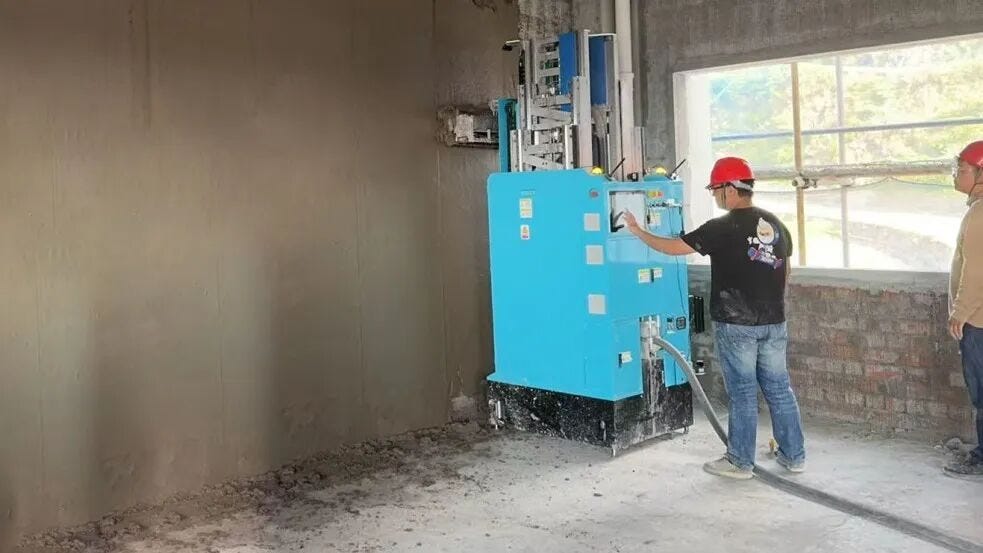
Before starting WEIBUILD, Liang Yanxue spent about a decade developing industrial robots at Japan’s FANUC and went on to work on construction robots at Country Garden, a Chinese property developer. In a 2024 interview with UrbanLab, he explained what drew him to construction. Factories had automated much of their work, while plasterers still learned the trade on the job. WEIBUILD began developing its plastering robot in 2020. The team brought in experienced plasterers, studied their movements and turned them into instructions the machine could follow. Its timeline puts the first tests in early 2021.
How Much Time Can a Plastering Robot Save?
The company’s cofounder and CTO, Jiazhen Mao, coauthored a June 2025 study with researchers from Kajima, a Japanese contractor, and the National University of Singapore. They used data from a plastering robot deployed in Singapore to estimate how long two teams would take to prep and plaster the same ten apartments. Each team had three people. The manual crew had one plasterer and two helpers. The robot crew had one plasterer, one helper and a robot operator.
In the study’s model, the manual crew takes 180hrs, with 20hrs to prep the walls and 160hrs to plaster them. The robot crew plasters the same walls in 32hrs, an 80% reduction in plastering time. That crew has the same 20hrs of prep to do. The model counts those hours within the 32hrs because it assumes workers can clean and mark out the next room while the robot plasters the current one. That brings the estimated saving to 82% for prep and plastering together.
How Much Wall Can the Robots Cover?
Plastering. In the company’s planning example, two workers with a robot cover 300 m²/day, matching six skilled plasterers at an assumed average of 50 m²/day each. At a January 2025 demo in Dubai, the company reported that its robot plastered 26 m² in 24 min and estimated that was 8–10× the rate of hand plastering.
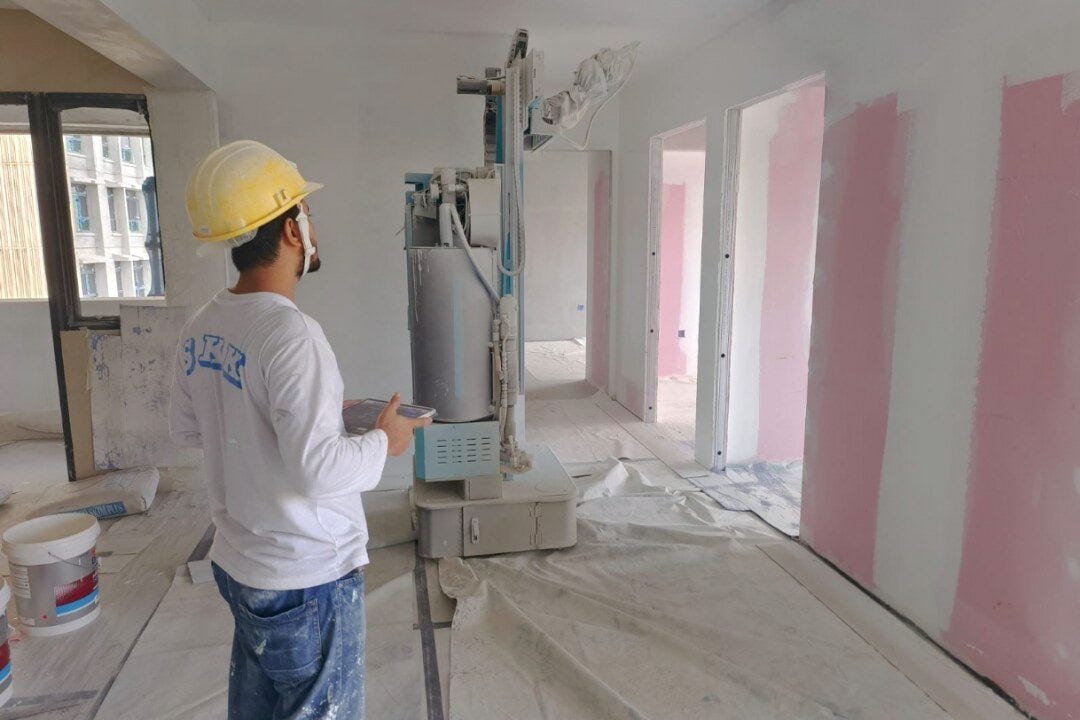
Paint and putty. In a separate company estimate, paint output is 533 m²/day per robot versus 200 m²/day per painter (2.7×). For putty, the thin coat that smooths a wall before painting, it estimates 266 m²/day per robot versus 75 m²/day per worker (3.5×). The paint example assigns two workers to four robots.
Sprayer ratings. The company rates its residential and high-reach sprayers at 300 and 375 m²/h for one coat of paint, or 200 and 250 m²/h for putty. Both list 4hrs of battery life. The taller model can spray up to 6 m above the floor. The paint ratings for long, uninterrupted walls are 450 and 650 m²/h. Singapore equipment supplier BES lists paint rates of 260 and 300 m²/h for the two models.
Painting on site. Liang puts the NS Square ceiling job at 10× manual efficiency, with timing and crew size unspecified. For comparison, a different robot in Singapore contractor Hi-Tek’s pilot painted a four-room flat in 90 min. Singapore’s Building and Construction Authority estimated three painters would take 70 min.
In November 2026, WEIBUILD said it had raised more than $15 million from Caitong Capital (财通资本), the private equity arm of Zhejiang brokerage Caitong Securities. The investor, which has backed manufacturers including EV maker Leapmotor, cited the difficulty of recruiting younger construction workers and the potential to sell the robots overseas. WEIBUILD plans to use the money to expand manufacturing, enter more markets, and fund further product and AI development. Liang says the company will adapt its wall robots to local building practices overseas. It’s also discussing other applications, such as spraying fire-resistant coatings onto modular units for data centers.
You Missed a Spot
The robot crew in the study still needed a plasterer to finish the corners and edges the machine couldn’t reach.
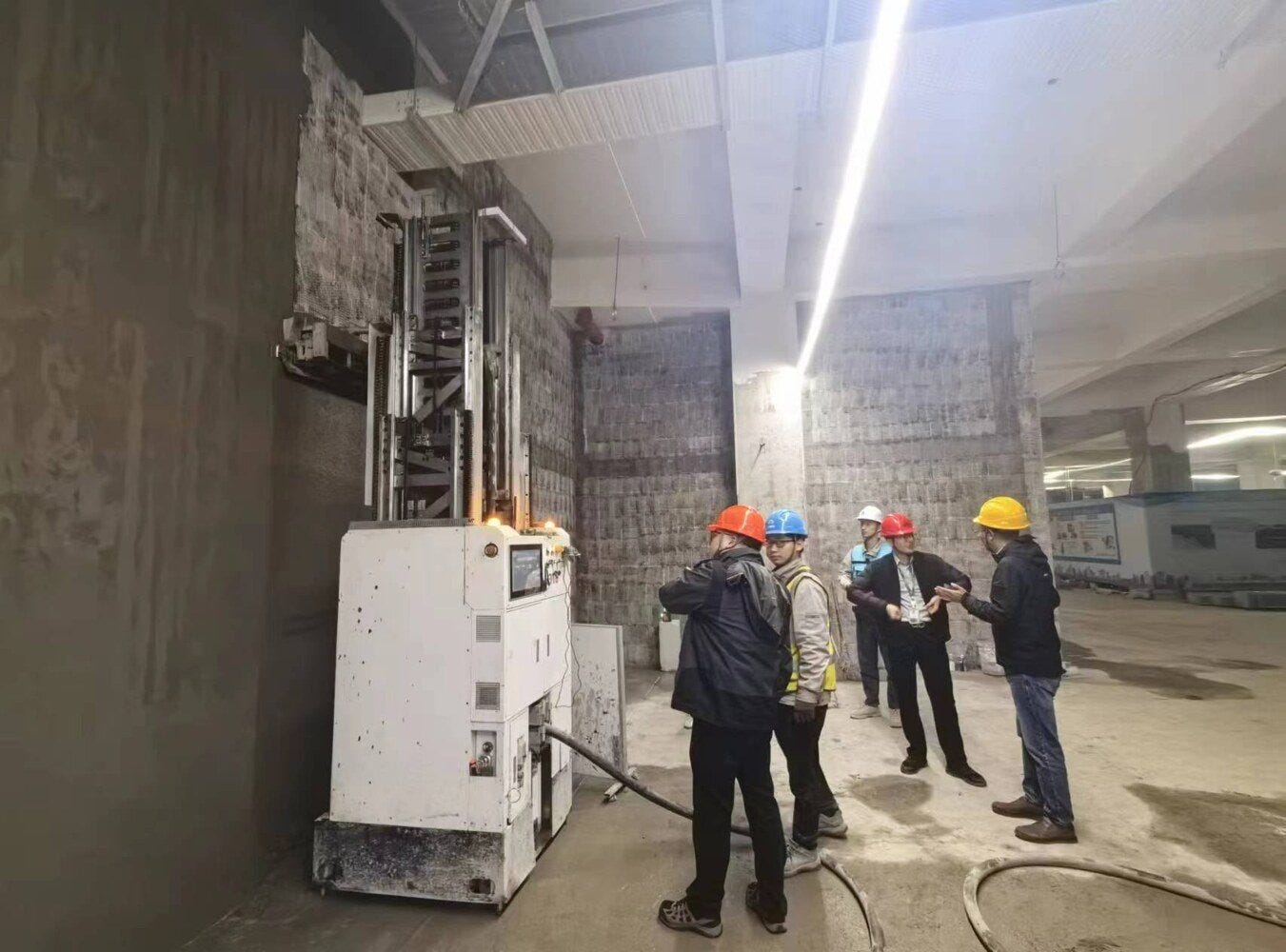
WEIBUILD’s plastering machine pumps mortar to a moving head that presses it against the wall and smooths the surface. Its paint sprayer maps the room and controls how far the nozzle sits from the wall as it moves. Liang says WEIBUILD spent years refining the controls that help its robots produce a consistent finish.
Who Keeps the Machines Running?
Both crews in the plastering study had three people. The model gave the robot crew a shorter job. On a large housing project, that could let the same crew get through more flats in the same time.
Singapore’s Housing & Development Board said in its 2024–25 annual report that about half its new public housing sites had started using robots for work including painting. The board pools demand across projects to help builders get equipment at competitive prices. In April 2025, the board awarded a roughly $95,000 contract for robot painting services at selected housing sites to Linkwise Technology, WEIBUILD’s Singapore partner. Dafang AI, another robotics supplier, won a separate contract for the same type of work. Later that month, WEIBUILD said it had made its first deliveries to Singapore and trained local crews to run the machines.
Asher Lum, an assistant project director with Expand Construction, the main contractor at NS Square, says getting crews to keep using a robot is harder than buying one. Liang says entering coordinates and choosing settings can make the robots hard for crews to use.
That’s where Liang wants AI to help. WEIBUILD’s Tiangong control system combines the controls that guide the robot’s movements with software that can identify different parts of a scene. Liang described two ways he’d like to make the machines easier to operate. One is to make the controls as simple as tapping a phone screen. The other is to let workers give instructions in ordinary language.
In Singapore, BES sells and rents the sprayers and provides maintenance and training.
WEIBUILD sent technicians and provided remote help on its Zhejiang team’s first project, a new facility for a ship repair company in Zhoushan. The technicians met with the customer to discuss how to mix the mortar and keep it pumping steadily. A stiff mix is hard to push through the hose. Too much water and the plaster can sag on the wall.
The Hours Between Jobs
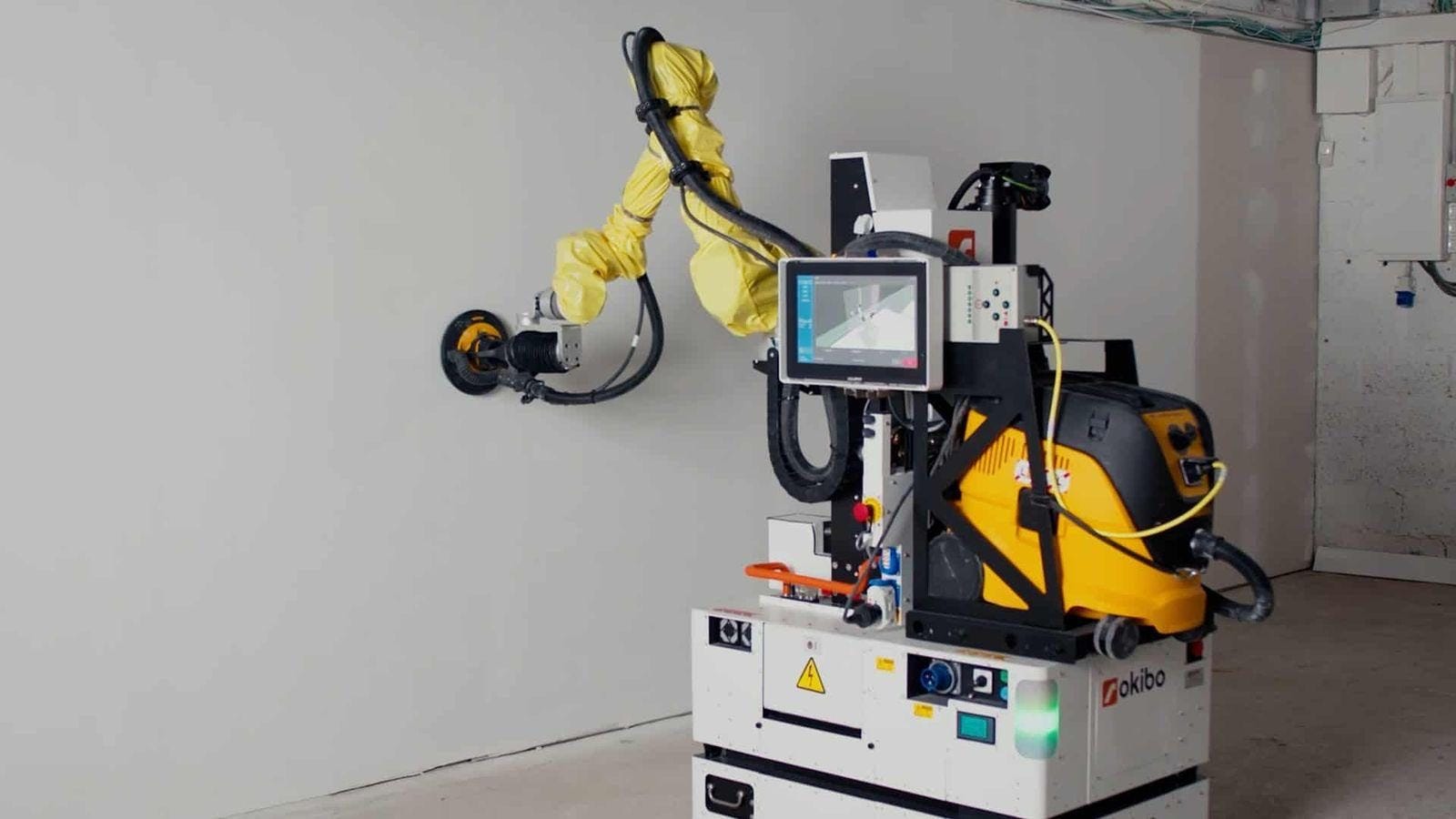
A crew may have a full day’s work while a dedicated spraying robot waits for a wall to be ready. Okibo, a rival that has deployed machines on US construction sites, offers a robot that can do drywall finishing, sanding, and painting. By changing tools, a crew can use the same machine at several stages of a job.
The Singapore plastering paper’s separate cost model assumes 250 working days without downtime. It sets both crews a target of 300 m² per 8hr shift, with 12 workers doing it by hand or three with a robot. The robot crew’s operating costs come out 31% lower in the model. Most of the savings come from the plastering itself. Edge finishing and equipment running costs are higher for the robot crew. The model excludes the robot’s purchase price.
The robot does what you’d want it to do on a plastering job. It takes on the bulk of the hard, repetitive work of spreading and smoothing mortar. The crew moves it into place, gets the next room ready while it runs, and finishes the corners and edges by hand. In the Singapore study’s three-person comparison, one of the jobs on the crew goes from helping the plasterer to running the machine.
In Hi-Tek’s painting pilot, Singapore’s Building and Construction Authority said one worker could run two robots from a tablet and keep work going in two flats at once. That matters for contractors struggling to hire.
I think more construction work will look like this. The machines do the bulk of the hard work, the crew runs them and finishes by hand, and the same people get more done. Are we going to see an increasing number of tradesmen become robot operators?